
Menthol Cooling Gel: How It Works, Uses and Safety Guide
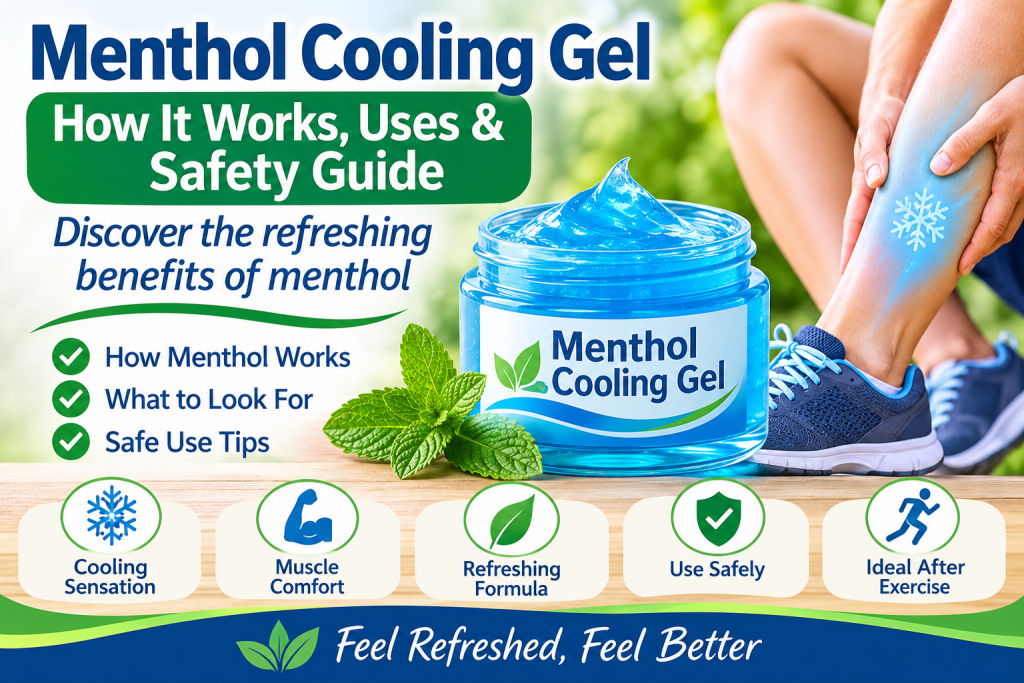
Menthol cooling gel is a popular choice for people looking for a refreshing topical product as part of their everyday wellbeing routine. Commonly used after exercise, physical activity or a long day on your feet, these gels are recognised for the cooling sensation they create when applied to the skin.
Menthol is a familiar ingredient in many topical products, including cooling gels, massage preparations, medicated oils and muscle rubs.
But how does menthol actually create a cooling sensation? What should you look for when choosing a menthol cooling gel, and are there any precautions to consider?
In this guide, we’ll explore how menthol works, why it is used in topical products, the differences between various formulations and how to use cooling gels responsibly.
What Is Menthol Cooling Gel?
Menthol cooling gel is a topical preparation designed to create a cooling sensation when applied to the skin.
Its main cooling ingredient is menthol, a compound naturally found in mint oils that can also be manufactured for use in commercial products.
Menthol is widely used in:
- Cooling gels.
- Massage preparations.
- Sports rubs.
- Medicated oils.
- Balms and creams.
- Other topical wellbeing products.
The exact formulation varies between manufacturers. Some gels contain menthol as their main active ingredient, while others combine it with additional ingredients.
Depending on the product, these may include eucalyptus oil, camphor, botanical extracts or other components.
The texture can also vary. Some cooling gels are lightweight and water-based, while others have thicker formulations designed to spread across the skin.
Always check the product label to understand its ingredients and intended use.
How Does Menthol Create a Cooling Sensation?
One of the most interesting things about menthol is that it can make your skin feel cold without necessarily lowering its actual temperature by the same amount.
This happens because menthol interacts with sensory receptors in the skin.
One important receptor is called TRPM8, which is involved in detecting cold temperatures.
When menthol activates these receptors, the nervous system receives signals associated with coolness.
This is why applying a menthol cooling gel can create a refreshing sensation, even when the product itself is not particularly cold.
Does menthol actually cool the muscles?
Not necessarily.
The cooling sensation is primarily a sensory response involving receptors in the skin.
It should not be confused with physically cooling deeper muscle tissue or treating the underlying cause of discomfort.
This distinction is important when comparing topical cooling products with physical cold treatments, such as an ice pack or reusable cooling pack.
Menthol creates a cooling sensation, while a cold pack works through actual temperature reduction.
Why Is Menthol Used in Cooling Gels?
Menthol is widely used in topical formulations because of its distinctive cooling properties and familiar refreshing sensation.
There are several reasons why manufacturers include it in cooling gels.
1. Creates a refreshing sensation
The most recognisable feature of menthol is its ability to produce a cooling feeling when applied to the skin.
Many people prefer this sensation after physical activity or as part of a massage routine.
The strength and duration of the sensation depend on the formulation and individual sensitivity.
2. Commonly used in massage products
Menthol appears in many topical massage preparations.
Depending on the product, it may be combined with other ingredients to create a particular sensory experience.
Always choose a product specifically intended for the type of application you have in mind.
3. Available in different formulations
Menthol is not limited to cooling gels.
It can also be found in creams, sprays, lotions, oils and balms.
This gives consumers different textures and application methods to consider when comparing products.
4. Used in certain topical pain-relief products
Some medicinal topical products contain menthol and are intended for the temporary relief of particular types of pain.
However, not every cooling gel is a medicine, and the presence of menthol alone does not mean that a product has been proven to treat a particular condition.
Always check the product’s intended use and regulatory information.
What Are the Differences Between Menthol Cooling Gels?
Not all menthol cooling gels are the same.
They can differ in their concentration, ingredients, texture and intended purpose.
Understanding these differences can help you compare products more confidently.
Lightweight cooling gels
These products are often designed to spread easily across the skin.
Their lighter texture may appeal to people who prefer a less oily finish.
Menthol massage gels
Some products are specifically formulated for massage.
They may contain menthol alongside additional ingredients that influence the texture, aroma and overall application experience.
Check that the product is suitable for massage before using it in this way.
Cooling gels with additional ingredients
Some formulations combine menthol with ingredients such as camphor or eucalyptus oil.
These combinations can produce a different sensory experience from products containing menthol alone.
The suitability of the product depends on its complete formulation rather than any one ingredient.
Medicinal cooling gels
Some topical gels containing menthol are classified as medicinal products.
These have specific product information, intended uses and instructions that should be followed carefully.
Do not assume that a general cosmetic or massage gel has the same properties or uses as a licensed medicinal preparation.
Menthol Cooling Gel vs Menthol Oil
Although both products may contain menthol, cooling gels and menthol oils can feel quite different when applied.
| Feature | Menthol Cooling Gel | Menthol Oil |
|---|---|---|
| Texture | Usually gel-based | Liquid or oil-based |
| Application | Generally spread over the skin | Applied according to the product instructions |
| Finish | Often lighter and less oily | May leave an oily residue |
| Sensation | Commonly provides a cooling feeling | Depends on its ingredients and formulation |
| Product types | Cooling gels and topical preparations | Massage oils and medicated oils |
| Ingredients | May contain menthol and other ingredients | May contain menthol and other aromatic ingredients |
Neither format is automatically better.
Your choice may depend on the texture you prefer, the intended use and the instructions provided by the manufacturer.
For a more detailed comparison, read our article: Menthol Oil for Massage: What to Look For and How to Use It.
What Should You Look for When Choosing a Menthol Cooling Gel?
If you are comparing menthol cooling gels, there are several things worth considering before making a purchase.
1. Check the menthol content
Look at the ingredient list and product information to see whether menthol is included.
Where the concentration is disclosed, compare it with the manufacturer’s intended use and instructions.
A stronger cooling sensation does not automatically mean a better product.
Research into topical menthol formulations has also shown that the relationship between menthol concentration and perceived cooling is not necessarily straightforward.
2. Consider the complete ingredient list
Menthol may be combined with other ingredients, including:
- Camphor.
- Eucalyptus oil.
- Botanical extracts.
- Fragrance ingredients.
- Other topical compounds.
Check the complete list, particularly if you have sensitive skin or known allergies.
3. Choose a suitable texture
Some people prefer lightweight gels that spread easily, while others prefer thicker preparations.
Consider how you intend to use the product and whether the texture suits your preference.
4. Check the intended use
Not every cooling gel is designed for the same purpose.
Some are intended for general cosmetic use, others for massage, and some are medicinal products with specific indications.
Read the packaging carefully before choosing.
5. Buy from a reputable supplier
Look for clear product descriptions, ingredient information, manufacturer details and appropriate safety instructions.
Avoid products with unclear labelling or exaggerated claims about what their ingredients can achieve.
How to Use Menthol Cooling Gel Safely
Although menthol cooling gels are widely available, they should still be used responsibly.
Always follow the instructions supplied with the specific product.
Here are some general precautions to remember.
Apply as directed: Use the recommended amount and frequency. Applying more product does not necessarily provide a stronger or better result.
Avoid sensitive areas: Keep the product away from your eyes, mouth and other sensitive areas.
Do not apply to damaged skin: Avoid using cooling gels on broken, irritated or damaged skin unless the product instructions specifically allow it.
Wash your hands: Wash your hands after application to prevent accidental contact with your eyes or mouth.
Avoid external heat: Do not use heating pads or hot-water bottles over areas treated with menthol products unless the manufacturer specifically confirms this is safe.
Do not combine products unnecessarily: Avoid applying several topical preparations to the same area without professional advice.
Stop if irritation develops: Discontinue use if you experience unexpected burning, itching, redness or a rash.
Can menthol cooling gel irritate the skin?
Yes.
Although many people tolerate appropriately formulated menthol products, some individuals may experience skin irritation or sensitivity.
The reaction can depend on the concentration, complete formulation and individual skin sensitivity.
If you have sensitive skin or a history of allergic reactions, check the product information carefully and ask a pharmacist if you are unsure.
Can children use menthol cooling gels?
Not all menthol products are suitable for children.
Age restrictions vary depending on the formulation and intended use.
Always check the manufacturer’s instructions and seek advice from a pharmacist or healthcare professional if you are unsure.
Keep all topical products securely stored and out of children’s reach.
Can menthol cooling gel be used every day?
That depends on the specific product and its instructions.
Do not exceed the recommended application frequency or amount.
If you find yourself needing a topical product regularly because of persistent discomfort, consider speaking to a healthcare professional.
Menthol Cooling Gel and Your Everyday Wellbeing Routine
Menthol cooling gels can be incorporated into different everyday routines, depending on the product and its intended use.
For example, some people prefer a refreshing topical product after:
- Walking or spending long periods on their feet.
- Running or other physical activity.
- Exercise at the gym.
- Sports and recreational activities.
- A massage routine.
However, a cooling gel should not be viewed as a replacement for appropriate exercise recovery, rest, hydration or medical care.
If discomfort is persistent, severe, worsening or unexplained, seek appropriate medical advice rather than relying solely on topical products.
Frequently Asked Questions
What does menthol cooling gel do?
Menthol cooling gel creates a cooling sensation when applied to the skin. Menthol activates sensory receptors associated with detecting cold, producing a refreshing feeling. The sensation does not necessarily mean that deeper muscle tissue is being cooled.
Does menthol actually lower skin temperature?
Menthol primarily creates a sensation of coolness by interacting with sensory receptors. Some formulations may also influence measured skin temperature, but the cooling sensation and actual temperature change are not the same thing.
Is menthol cooling gel the same as ice gel?
No. Menthol cooling gels create a cooling sensation through their ingredients, while physical cooling packs work by transferring heat away from the body. They are different types of product.
Is menthol cooling gel suitable after exercise?
Some people choose menthol cooling gels as part of their post-exercise routine because of their refreshing sensation. However, products vary, so check the intended use and application instructions.
Can I use menthol cooling gel with a massage?
Some menthol gels are specifically formulated for massage. Check the product label before using a cooling gel in this way.
Is a higher menthol concentration better?
Not necessarily. A higher concentration does not automatically produce a better cooling experience or make a product more suitable. Formulation and individual sensitivity also matter.
Can I use menthol cooling gel with other topical products?
Avoid combining topical preparations on the same area unless a pharmacist or healthcare professional has confirmed that doing so is appropriate.
Is menthol cooling gel suitable for sensitive skin?
It depends on the formulation and individual sensitivity. Menthol and other ingredients can irritate some people’s skin. Check the ingredient list and seek professional advice if you have concerns.
Final Thoughts: Choosing a Menthol Cooling Gel
Menthol cooling gels are popular because they offer a familiar refreshing sensation and are available in a variety of formulations.
Whether you prefer a lightweight gel, a massage preparation or a more traditional topical product, understanding the ingredients and intended use can help you make a more informed choice.
Remember that a cooling sensation is not the same as physically cooling deeper tissues or treating an underlying medical condition.
Take the time to compare products, read the ingredient list and follow the manufacturer’s instructions.
At Alternative Wellbeing, our aim is to help you understand familiar topical ingredients and make informed choices about the products you use as part of your everyday wellbeing routine.
Disclaimer
This article is provided for general informational and educational purposes only. It is not intended to provide medical advice, diagnose or treat any medical condition, or replace advice from a qualified healthcare professional.
Menthol cooling gels and other topical preparations vary in their ingredients, concentrations, intended uses and safety information. The presence of menthol does not mean that every product has been clinically proven to provide a particular benefit.
Always read the product label and follow the manufacturer’s instructions. Do not exceed the recommended amount or frequency of application. Avoid contact with the eyes, mouth and sensitive areas. Keep all topical products out of the reach of children.
If you have sensitive skin, known allergies, an existing medical condition, take regular medication, or are pregnant or breastfeeding, consult a pharmacist or healthcare professional if you are unsure whether a product is suitable for you.
Seek appropriate medical advice for persistent, severe, worsening or unexplained symptoms. If you suspect that someone has swallowed a potentially harmful topical product, seek urgent medical advice.
Never use the information in this article as a substitute for professional medical advice, diagnosis or treatment.