
Menthol Oil vs Medicated Oil: What’s the Difference?
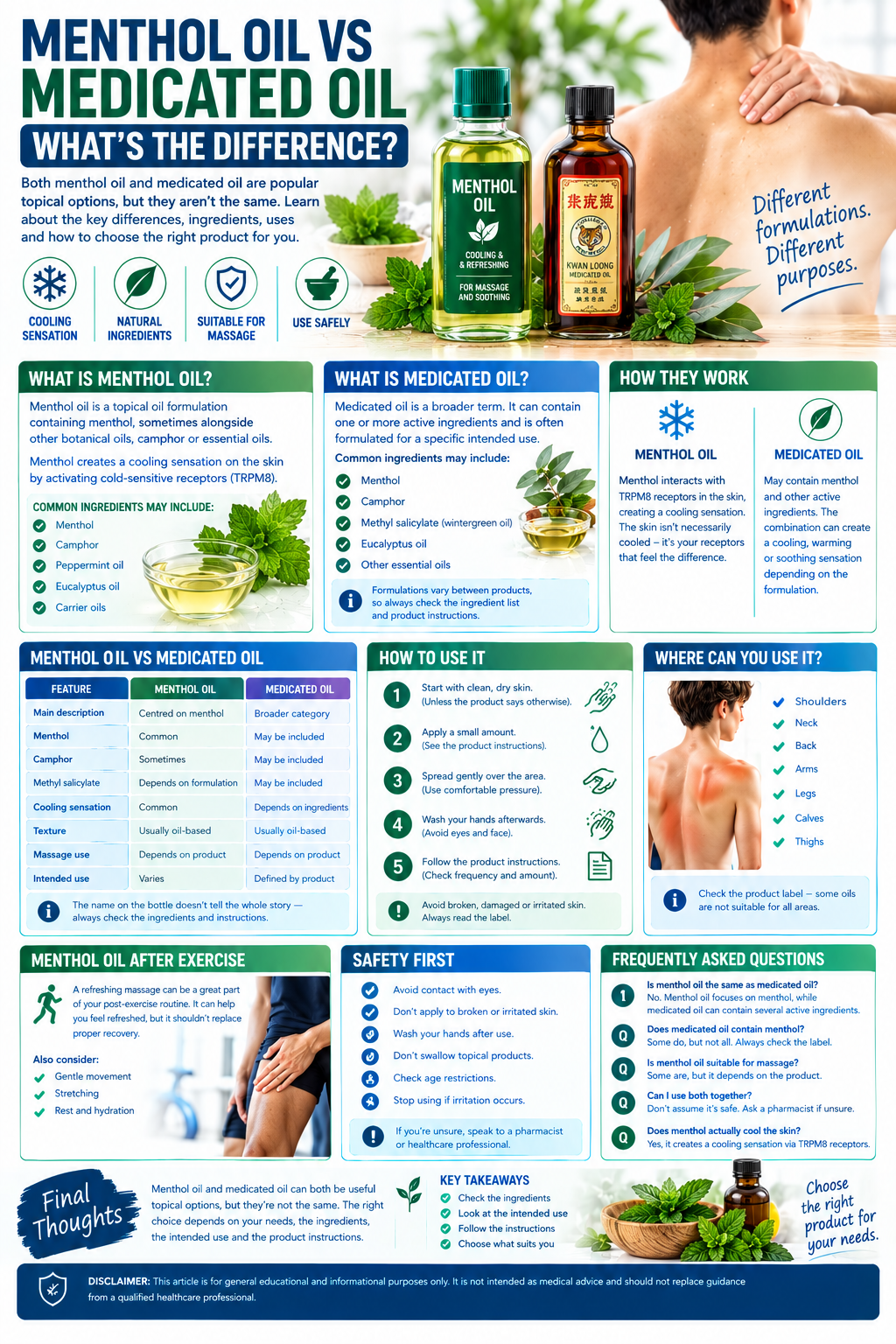
When looking for a topical oil, you may come across products described as menthol oil, medicated oil, cooling oil or massage oil.
At first glance, they can appear very similar. Many contain familiar ingredients such as menthol, camphor, eucalyptus oil or other aromatic ingredients.
However, the terms don’t necessarily mean the same thing.
A menthol oil generally describes a product containing menthol and is often associated with a cooling or refreshing sensation. A medicated oil may contain a wider combination of active ingredients and have a specific intended use stated by the manufacturer.
So, what’s the difference between them, and how do you decide which type of product is appropriate for your needs?
Let’s take a closer look.
Important: This article is for general educational information only. Topical oils vary considerably in their ingredients, intended uses and directions. Always read the product packaging and follow the manufacturer’s instructions.
What Is Menthol Oil?
Menthol oil is a topical oil formulation containing menthol.
Menthol is well known for creating a cooling sensation when applied to the skin. It does this by interacting with cold-sensitive receptors, including TRPM8 receptors, which are involved in detecting cool temperatures.
The result is the familiar refreshing sensation associated with many menthol products.
A menthol oil may contain menthol as its main feature, or it may combine menthol with other botanical or aromatic ingredients.
Depending on the formulation, it may be used as part of:
- A massage routine
- Post-exercise self-care
- An everyday wellbeing routine
- A refreshing topical application
However, not every menthol oil is the same, so checking the ingredients and instructions is important.
What Is Medicated Oil?
“Medicated oil” is a broader description.
Rather than referring to one specific ingredient, it can describe a topical product formulated with one or more active ingredients for a particular intended use.
For example, some medicated oils contain combinations of ingredients such as:
- Menthol
- Camphor
- Methyl salicylate
- Eucalyptus oil
- Other essential or aromatic ingredients
The exact formulation depends on the individual product.
For example, regulatory product information for Kwan Loong Oil lists it as a topical liquid and identifies menthol-containing ingredients alongside other components.
This is why you shouldn’t assume that every product labelled “medicated oil” has the same ingredients or should be used in exactly the same way.
Menthol Oil vs Medicated Oil: The Main Difference
The simplest way to think about it is:
Menthol oil describes a type of formulation or key ingredient.
Medicated oil describes a product intended for a particular purpose and may contain several active ingredients.
There can therefore be considerable overlap.
A medicated oil may contain menthol, while a menthol oil doesn’t necessarily have the same formulation or intended use as a particular medicated oil.
A Simple Comparison
| Feature | Menthol Oil | Medicated Oil |
|---|---|---|
| Main description | Often centred around menthol | Broader product category |
| Menthol | Common | May be included |
| Camphor | Sometimes included | May be included |
| Methyl salicylate | Depends on formulation | May be included |
| Cooling sensation | Common | Depends on ingredients |
| Oil-based | Usually | Usually, but check product |
| Massage use | Depends on product | Depends on product |
| Intended use | Depends on formulation | Defined by individual product |
| Instructions | Product-specific | Product-specific |
The important point is that the product label matters more than the name alone.
Why Does Menthol Feel Cool?
One of the biggest reasons people associate menthol oils with cooling is the way menthol interacts with sensory receptors in the skin.
Menthol can activate TRPM8 receptors, which are sensitive to cool temperatures.
This produces a sensation of coolness even though the product isn’t necessarily physically cold.
That’s why applying a menthol-containing oil can create a noticeable refreshing sensation.
The intensity varies between products and individuals.
A stronger cooling sensation isn’t automatically an indication that one product is better than another.
What About Camphor?
Camphor is another ingredient frequently encountered in traditional topical oils.
It can contribute to the overall sensory experience of a product and is sometimes combined with menthol.
The combination of menthol and camphor is particularly familiar in traditional topical preparations.
However, formulations vary, so always check the individual product’s ingredient list.
What Is Methyl Salicylate?
Another ingredient you may encounter in some medicated oils is methyl salicylate, sometimes referred to as wintergreen oil.
Methyl salicylate is chemically related to salicylates and is used in some topical preparations.
This is one reason why you shouldn’t assume that all “cooling oils” are interchangeable.
A product containing methyl salicylate may have different warnings and precautions from a simple menthol-based oil.
If you take medicines containing salicylates or have concerns about whether a product is suitable for you, ask a pharmacist or healthcare professional before using it.
Menthol Oil vs Medicated Oil for Massage
This is where the difference becomes particularly useful.
If you’re specifically looking for something to use during massage, don’t choose a product based purely on whether the bottle says “menthol” or “medicated”.
Instead, check whether the manufacturer specifically recommends the product for massage.
Some oil-based products are designed to provide lubrication and may be appropriate for massage.
Others are intended primarily as topical preparations and may have different application instructions.
Always follow the directions supplied with the product.
Which One Should You Choose?
There isn’t one answer that applies to everyone.
Your choice should depend on what you’re looking for.
Choose a menthol oil if:
- You specifically want a menthol-containing product.
- You enjoy the refreshing sensation of menthol.
- You prefer an oil-based formulation.
- The product instructions suit your intended use.
Consider a medicated oil if:
- You’re looking for a product with a specific intended use.
- You want a formulation containing several active ingredients.
- You have a particular product in mind and its stated indications are relevant to you.
- You are comfortable following its specific directions and precautions.
Most importantly, read the label rather than relying on the product category alone.
Is Medicated Oil Stronger Than Menthol Oil?
Not necessarily.
The word “medicated” doesn’t automatically mean that a product will feel stronger.
The sensation you experience depends on the formulation and ingredients.
For example, two products could both contain menthol but produce noticeably different sensations because they contain different concentrations or additional ingredients.
Similarly, a medicated oil may contain several ingredients without necessarily producing a stronger cooling sensation.
Stronger does not automatically mean better.
For everyday topical use, comfort and suitability are more important than simply choosing the product with the strongest sensation.
Can You Use Medicated Oil and Menthol Oil Together?
Generally, you shouldn’t assume that combining two topical products is appropriate.
If both products contain similar or overlapping ingredients, using them together could increase exposure to those ingredients and potentially increase the chance of skin irritation.
Instead, use one product according to its instructions.
If you’re considering combining topical products, particularly products containing medicinal ingredients, ask a pharmacist for advice.
How Should You Apply a Topical Oil?
Always follow the instructions for your specific product.
In general:
1. Check the label
Make sure the product is intended for the area where you want to use it.
2. Use the recommended amount
Don’t assume that applying more will produce better results.
3. Apply to suitable skin
Avoid broken, damaged or irritated skin unless the product specifically says otherwise.
4. Massage gently if appropriate
Only massage the product if the manufacturer’s instructions allow it.
5. Wash your hands afterwards
This helps prevent accidental transfer to your eyes or other sensitive areas.
6. Avoid the eyes and mucous membranes
Take particular care when applying products containing menthol, camphor or other strong aromatic ingredients.
What About Kwan Loong Medicated Oil?
Kwan Loong Medicated Oil is a good example of why it’s important to look at the actual formulation rather than simply the product name.
Official regulatory information from Canada identifies Kwan Loong Oil as a topical liquid, with directions and warnings specific to that product.
Regulatory information from Thailand also lists Kwan Loong Medicated Oil formulations containing ingredients including methyl salicylate, menthol, camphor and eucalyptus oil.
Because formulations, markets and packaging can vary, always check the bottle or packaging you have purchased for the applicable ingredients and instructions.
For a more detailed explanation, see our dedicated article:
[What Is Kwan Loong Medicated Oil?]
Menthol Oil, Medicated Oil and Pain Relief Products
It’s also important not to confuse traditional topical oils with medicinal topical painkillers.
For example, some pharmacy gels contain medicines such as ibuprofen or diclofenac. These are topical NSAIDs and work differently from a traditional menthol or aromatic oil. NHS guidance recognises topical NSAIDs as medicines used for certain types of pain and inflammation.
A menthol-containing oil may create a cooling or warming sensory experience, but that doesn’t mean it works in the same way as an NSAID gel.
This distinction is particularly important when choosing a product.
Always check what the product actually contains and what it is licensed or intended to do.
Safety: What Should You Watch For?
Whatever type of topical oil you choose, follow the product instructions carefully.
Important precautions can include:
- For external use only where stated.
- Avoid contact with eyes.
- Don’t apply to broken or damaged skin.
- Wash hands after application.
- Don’t swallow topical products.
- Don’t use more frequently than recommended.
- Stop using the product if significant irritation develops.
- Keep products away from children.
- Check the label for age restrictions and other warnings.
Some medicated oils have additional warnings because of their particular ingredients.
For example, the regulatory information for Kwan Loong Oil advises external use only, avoiding eyes and mucous membranes, not applying to wounds or damaged skin, and stopping use if excessive irritation occurs.
When Should You Speak to a Healthcare Professional?
A topical oil shouldn’t be used to mask symptoms that need medical assessment.
For example, the NHS recommends seeking medical advice for back pain that doesn’t improve after a few weeks, interferes with daily activities or is associated with certain other symptoms.
Seek appropriate medical advice if you have:
- Persistent or worsening pain
- Severe unexplained pain
- Symptoms following a significant injury
- Swelling or other unusual symptoms
- Numbness or weakness
- Symptoms that interfere significantly with normal activities
If you’re unsure whether a topical product is suitable for you, a pharmacist can also provide advice.
Frequently Asked Questions
Is menthol oil the same as medicated oil?
No. Menthol oil generally refers to an oil containing menthol, while medicated oil is a broader category that can contain several active ingredients. There can be overlap between the two.
Does medicated oil contain menthol?
Some do, but not all. Always check the individual product’s ingredient list.
Is menthol oil suitable for massage?
Some menthol oils are suitable for massage, but this depends on the particular product. Always check the manufacturer’s instructions.
Is medicated oil stronger than menthol oil?
Not necessarily. The strength of the sensation depends on the individual formulation and ingredients.
Can I use menthol oil and medicated oil together?
Don’t assume that combining topical products is safe. They may contain overlapping ingredients. Follow the product instructions or ask a pharmacist if you’re unsure.
Does menthol actually cool the skin?
Menthol can create a cooling sensation by activating cold-sensitive receptors in the skin. The sensation doesn’t necessarily mean that the underlying tissues have physically cooled.
What is Kwan Loong Medicated Oil?
Kwan Loong Medicated Oil is a topical oil product. Its formulation and permitted uses can vary by market, so check the packaging and applicable product information before use.
Final Thoughts
The terms menthol oil and medicated oil can sound interchangeable, but they don’t necessarily describe the same type of product.
Menthol oil generally highlights the presence of menthol and its characteristic cooling sensation. Medicated oil is a broader description that can refer to a formulation containing several active ingredients and a specific intended use.
When choosing between products, don’t rely solely on the name on the bottle.
Instead, check:
- The ingredients
- The intended use
- The application instructions
- The warnings and precautions
- Whether the product is suitable for your intended purpose
And remember that different topical oils are not necessarily interchangeable.
for more information please refer to our other blog posts:
- What Is Kwan Loong Medicated Oil?
- Menthol Oil for Massage: What to Look For and How to Use It
- What Is Wintergreen Oil? Uses, Benefits and Safety Guide
- Why Is Menthol Used in Cooling Gels?
- Cooling Gel vs Menthol Oil
- Cooling Gel vs Warming Gel
- Cooling Gel for Back Comfort
- Cooling Gel for Neck and Shoulder Comfort
Disclaimer
This article is provided for general informational and educational purposes only. It is not intended to provide medical advice, diagnose or treat any medical condition, or replace advice from a qualified healthcare professional.
Menthol oils, medicated oils and other topical products vary in their ingredients, intended uses and safety information. Always read the product label and packaging carefully and follow the manufacturer’s instructions before use.
Individual ingredients may not be suitable for everyone. If you are taking medication, have an existing medical condition, are pregnant or breastfeeding, or are unsure whether a particular product is suitable for you, speak to a GP, pharmacist or other qualified healthcare professional.
If you experience persistent, severe, worsening or unexplained symptoms, seek appropriate medical advice rather than relying on a topical product.
Do not use this information as a substitute for professional medical advice, diagnosis or treatment.