
Cooling Gel for Neck and Shoulder Comfort: What to Look For
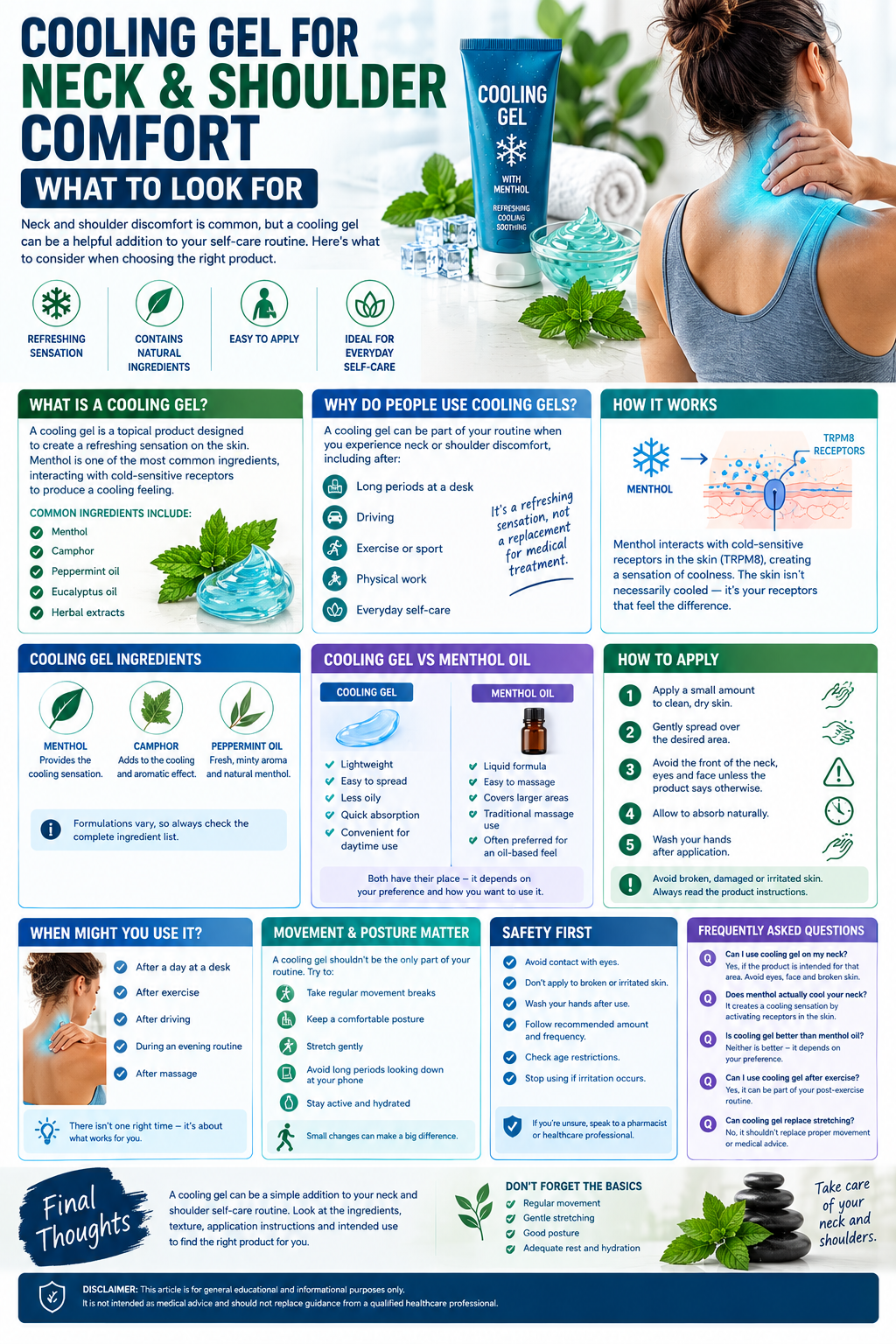
Neck and shoulder discomfort is something many people experience as part of everyday life. Spending long periods at a desk, using a phone, driving, exercising or simply staying in the same position for too long can all contribute to stiffness or discomfort.
A topical cooling gel can be one option people choose as part of their everyday self-care routine. Products containing menthol can create a noticeable cooling sensation on the skin, which many people find refreshing.
However, choosing a product isn’t simply about finding the strongest cooling sensation.
In this guide, we’ll look at what to consider when choosing a cooling gel for the neck and shoulders, how these products work, and some important safety considerations.
Why Do People Use Cooling Gels on the Neck and Shoulders?
The neck and shoulders are involved in many everyday activities, from working at a computer to driving and exercising.
When you’re sitting in the same position for long periods, taking regular movement breaks and maintaining comfortable posture can be helpful parts of an overall self-care routine. The NHS also recommends keeping the neck moving and trying flexibility exercises for general neck pain.
Some people also choose topical products such as cooling gels as part of their routine.
A cooling gel can provide a refreshing sensation on the skin, particularly when it contains menthol.
It’s important to distinguish this sensation from treating the underlying cause of neck or shoulder pain.
What Makes a Cooling Gel Feel Cold?
One of the most common ingredients in cooling gels is menthol.
Menthol interacts with cold-sensitive receptors in the skin, particularly TRPM8 receptors. This produces the familiar sensation of coolness.
The cooling sensation doesn’t necessarily mean that the underlying muscles or tissues have been significantly cooled.
This is why a menthol-containing gel can feel cold even when the product itself is at room temperature.
For more information, see our article:
Why Is Menthol Used in Cooling Gels?
What Ingredients Should You Look For?
When choosing a topical cooling product, look at the complete ingredient list.
Menthol
Menthol is the ingredient most commonly associated with the cooling sensation found in topical gels.
It provides a fresh, cooling feeling when applied to the skin.
Camphor
Camphor is frequently combined with menthol in traditional topical formulations.
It has a distinctive herbal aroma and contributes to the overall sensory experience.
Peppermint Oil
Peppermint oil has a fresh mint aroma and naturally contains menthol.
It is found in various massage and topical products.
Eucalyptus Oil
Eucalyptus oil provides a distinctive clean, herbal fragrance and can be found alongside menthol and other botanical ingredients.
The exact formulation varies between products, so always check the label.
Cooling Gel for the Neck vs Shoulders
Although the neck and shoulders are close together, they aren’t necessarily treated in exactly the same way.
Neck
The neck is a relatively sensitive area, so take particular care when applying topical products.
Avoid contact with the eyes and face, and don’t apply products to broken or irritated skin.
Shoulders
The shoulder area provides a larger surface for application and is often included in massage and self-care routines.
Always check that the specific product is intended for the area where you want to use it.
Cooling Gel vs Menthol Oil
If you’re deciding between a cooling gel and a menthol oil, the biggest difference is often the texture and application experience.
Cooling Gel
A cooling gel is generally:
- Lightweight
- Easy to spread
- Less oily
- Convenient for quick application
- Suitable for people who prefer a faster-absorbing texture
Menthol Oil
A menthol oil is:
- Liquid
- Easy to massage
- Useful over larger areas
- Popular in traditional massage routines
- Often preferred by people who enjoy an oil-based product
Neither is automatically the better option.
It depends on the experience you prefer and how you intend to use the product.
How to Apply Cooling Gel to Your Neck and Shoulders
Always follow the instructions supplied with your particular product.
If the product is intended for use on the neck and shoulders, general application may involve:
- Apply a small amount to clean, dry skin.
- Gently spread the product over the intended area.
- Avoid the front of the neck, eyes and face unless the product specifically says otherwise.
- Allow the gel to absorb naturally.
- Wash your hands after application.
Avoid applying topical products to broken, damaged or irritated skin.
If you’re using a product for the first time, read all warnings and directions carefully.
When Might People Use Cooling Gel?
There isn’t one particular time when a cooling gel needs to be used.
People may incorporate a cooling product into their routine:
After a Day at a Desk
If you’ve been sitting for long periods, taking regular movement breaks is important. A topical product may simply form part of your personal self-care routine.
After Exercise
Cooling products can be used as part of a post-exercise routine.
After Driving
Long journeys can involve sitting in one position for extended periods.
During an Evening Routine
Some people enjoy the refreshing sensation of a menthol-based product at the end of the day.
After Massage
Depending on the formulation, a cooling gel may be incorporated into a massage routine.
Don’t Forget Movement and Posture
A topical product shouldn’t be the only part of your approach to neck and shoulder comfort.
The NHS recommends keeping active and gently moving the shoulder for shoulder problems, while for general neck pain it recommends keeping the neck moving and trying flexibility exercises.
If you work at a desk, consider:
- Taking regular movement breaks
- Changing position regularly
- Keeping your screen at a comfortable height
- Avoiding prolonged periods looking down at a phone
- Sitting comfortably rather than remaining rigidly in one position
Small changes throughout the day can help you avoid spending long periods in the same posture.
Cooling Gel and Exercise
If you exercise regularly, a cooling gel may fit naturally into your post-exercise routine.
However, it shouldn’t replace a sensible warm-up, cool-down, recovery or professional assessment of an injury.
A good exercise routine should also include:
- Appropriate warm-ups
- Gradual increases in activity
- Rest and recovery
- Regular movement
- Adequate hydration
- Appropriate stretching or mobility work
What About Heat Instead?
Cooling isn’t the only option.
The NHS notes that both heat and cold packs can be used as part of self-care for neck and shoulder pain, depending on the situation and what feels helpful.
This is one reason why personal preference matters when choosing between cooling and warming products.
For a comparison, see:
Cooling Gel vs Warming Gel: Which Should You Choose?
How Strong Should the Cooling Sensation Be?
A common mistake is assuming that the strongest cooling sensation is automatically the best.
That’s not necessarily the case.
The experience can depend on:
- Menthol concentration
- Other ingredients
- Product formulation
- Amount applied
- Application area
- Individual sensitivity
A mild or moderate cooling sensation may be preferable to someone who finds stronger formulations uncomfortable.
Choose a product based on the overall formulation and your preferences rather than simply looking for the strongest possible sensation.
Important Safety Considerations
Always follow the manufacturer’s instructions.
When using a cooling product around the neck and shoulders:
- Avoid contact with the eyes.
- Don’t apply to broken or irritated skin.
- Wash your hands after application.
- Don’t apply more than the recommended amount.
- Follow any age restrictions on the packaging.
- Stop using the product if significant irritation occurs.
Take particular care around the face and neck because these areas are close to the eyes, nose and mouth.
If you’re unsure whether a particular product is appropriate for you, speak to a pharmacist or healthcare professional.
When Should You Seek Medical Advice?
A cooling gel is a topical self-care product and shouldn’t be used to mask symptoms that need medical attention.
For neck pain, the NHS advises seeking medical advice if the problem doesn’t go away after a few weeks, or if there are symptoms such as pins and needles or a cold arm.
For shoulder pain, the NHS advises seeking medical help if it is getting worse, doesn’t improve after two weeks, or if it’s very difficult to move the arm or shoulder.
Seek urgent medical help following a significant injury, particularly if you cannot move the arm, the shoulder has changed shape, or there is significant swelling.
These situations require appropriate medical assessment rather than relying on a topical product.
Frequently Asked Questions
Can You Use Cooling Gel on Your Neck?
Only if the particular product is intended for use on the neck. Always follow the manufacturer’s instructions and avoid contact with the eyes, face and broken skin.
Does Menthol Actually Cool Your Neck?
Menthol creates a cooling sensation by interacting with cold-sensitive receptors in the skin. The sensation doesn’t necessarily mean that the underlying tissues have been significantly cooled.
Is Cooling Gel Better Than Menthol Oil?
Neither is universally better. Cooling gels tend to be lightweight and convenient, while menthol oils can be particularly suitable for massage.
Can You Use Cooling Gel After Exercise?
Cooling gels can form part of a post-exercise self-care routine when used according to the manufacturer’s instructions.
Can Cooling Gel Replace Stretching?
No. A topical product shouldn’t replace appropriate movement, mobility exercises or professional advice.
What Ingredients Are Common in Cooling Gels?
Menthol is particularly common. Some products may also contain camphor, peppermint oil, eucalyptus oil or other botanical ingredients.
Final Thoughts
A cooling gel can be a simple addition to an everyday self-care routine for people who enjoy the refreshing sensation of menthol.
When choosing a product for the neck and shoulders, consider the ingredients, cooling sensation, texture, application instructions and intended use.
It’s also important to look beyond topical products. Regular movement, comfortable posture and appropriate exercise are all useful parts of maintaining everyday physical wellbeing.
And if neck or shoulder symptoms persist, become severe or are accompanied by concerning symptoms, seek appropriate medical advice rather than relying solely on a topical product.
For more information please refer to our other blog posts:
I’d link this article to:
- Why Is Menthol Used in Cooling Gels?
- Best Cooling Gels for Muscle Comfort in the UK
- Cooling Gel vs Warming Gel
- Cooling Gel vs Menthol Oil
- Menthol vs Camphor: What’s the Difference?
- Peppermint Oil vs Menthol: What’s the Difference?
- What Does Eucalyptus Oil Do in Topical Products?
- What Is Kwan Loong Medicated Oil?
Disclaimer
This article is for general educational and informational purposes only. It is not intended as medical advice and should not replace advice from a qualified healthcare professional.