
Menthol Oil for Massage: What to Look For and How to Use It
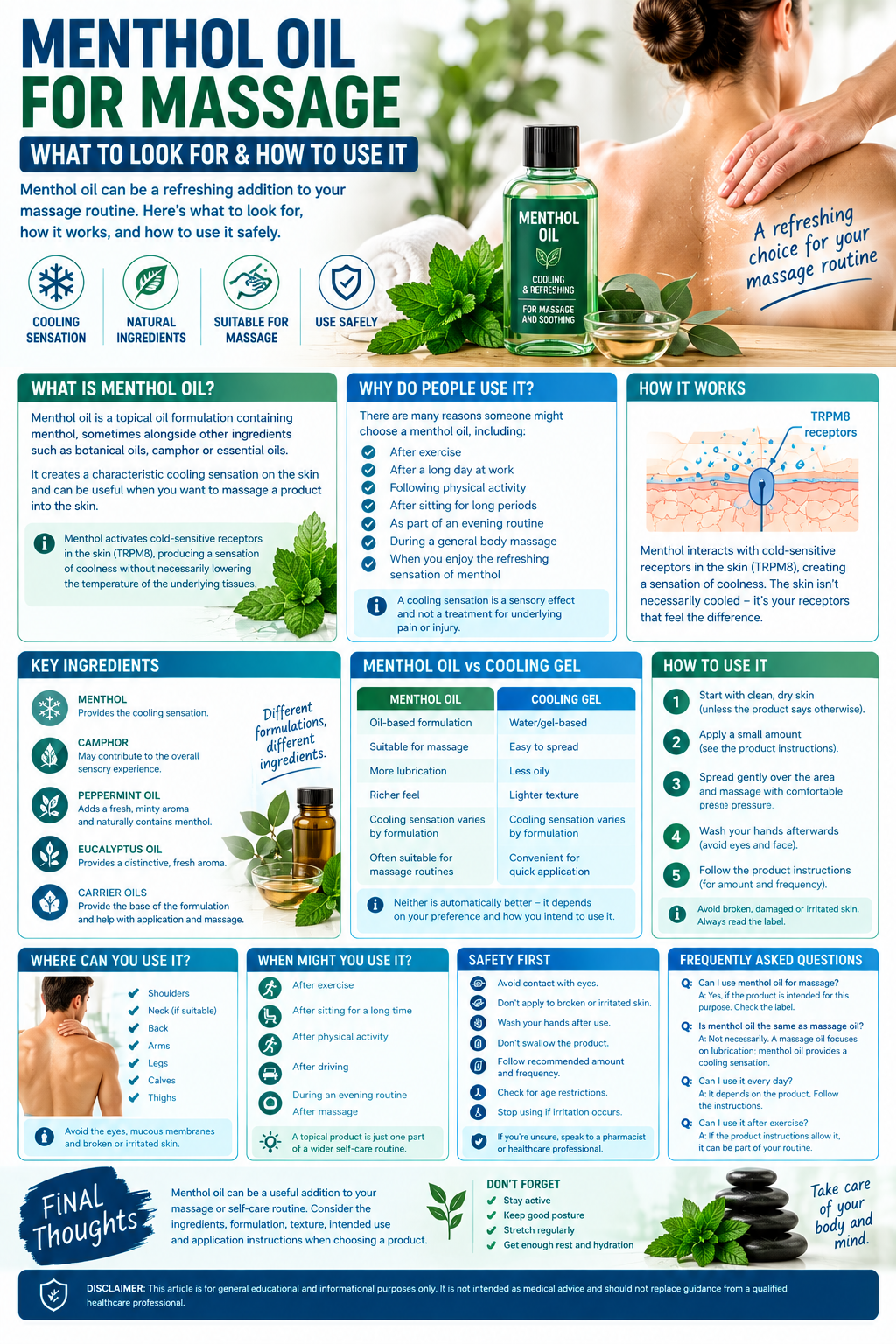
Massage has long been part of many people’s self-care routines, whether after exercise, following a long day at work or simply as a relaxing evening ritual.
For those who enjoy a refreshing sensation, menthol oil can be another option to consider.
Menthol-containing oils are designed to create a characteristic cooling sensation when applied to the skin. Some formulations are also intended to provide a suitable surface for massage.
But what should you look for when choosing a menthol oil, and how should you use one?
This guide explains the basics, including ingredients, application, massage techniques and important safety considerations.
Important: Menthol oils are topical products intended for use on the skin. They are not a replacement for medical assessment or treatment. If you have persistent, severe or unexplained pain, speak to a healthcare professional.
What Is Menthol Oil?
Menthol oil is a topical oil formulation containing menthol, sometimes alongside other ingredients such as botanical oils, camphor or essential oils.
Unlike a water-based cooling gel, an oil has an oil-based texture that can make it useful when you want to massage a product into the skin.
One of the most noticeable characteristics of menthol is its cooling sensation.
Menthol activates cold-sensitive TRPM8 receptors in the skin, producing a sensation of coolness without necessarily lowering the temperature of the underlying tissues.
This is why menthol-containing products can feel refreshing when applied during or after a massage.
Why Do People Use Menthol Oil for Massage?
There are several reasons someone might choose a menthol oil as part of their massage routine.
For example, you might use one:
- After exercise
- After a long day at work
- Following physical activity
- After spending a long time sitting
- As part of an evening self-care routine
- During a general body massage
- When you enjoy the refreshing sensation of menthol
The massage itself and the sensory experience from the product are separate things.
It’s therefore useful to think of menthol oil as a topical self-care product, rather than assuming that the cooling sensation means it is treating the underlying cause of discomfort.
How Does Menthol Create a Cooling Sensation?
The cooling sensation associated with menthol is surprisingly interesting.
Your skin contains sensory receptors that respond to temperature. One of the most important receptors involved in detecting cool temperatures is TRPM8.
Menthol can activate these receptors, sending signals to the nervous system that are perceived as coolness.
This explains why menthol oil can feel cool even when the oil itself isn’t cold.
Cooling doesn’t necessarily mean colder skin
This distinction is important.
When you apply a menthol product, the sensation of coolness doesn’t automatically mean that the deeper tissues have been physically cooled.
You’re primarily experiencing a sensory response from the skin.
The intensity of that sensation can vary depending on the formulation and concentration of menthol. Higher concentrations can sometimes produce unpleasant sensations such as burning or irritation rather than simply feeling refreshing.
What Ingredients Might You Find in Menthol Oil?
Different products use different formulations, so always check the individual ingredient list.
Menthol
Menthol is the ingredient responsible for the familiar cooling sensation found in many topical products.
Camphor
Camphor is sometimes combined with menthol in traditional topical formulations. Depending on the formulation, it can contribute to the overall sensory experience.
Peppermint oil
Peppermint oil naturally contains menthol and can provide a fresh, minty aroma.
Eucalyptus oil
Eucalyptus oil may be included for its distinctive botanical aroma.
Carrier oils
An oil-based product may also contain one or more carrier oils. These provide the base of the formulation and influence how easily the product spreads across the skin.
Because formulations vary, don’t assume that every menthol oil contains the same ingredients.
Menthol Oil vs Cooling Gel
If you’ve been looking at topical cooling products, you may have noticed that some come as gels while others are oils.
So what’s the difference?
| Menthol Oil | Cooling Gel |
|---|---|
| Oil-based formulation | Usually water/gel-based |
| Suitable for massage | Usually designed for easy spreading |
| More lubrication | Generally less oily |
| Can feel richer on the skin | Often feels lighter |
| Cooling sensation can vary by formulation | Cooling sensation can vary by formulation |
| Often suitable when massage is part of the routine | Convenient for quick application |
Neither format is automatically suitable for everyone.
Your choice depends on the type of product you prefer and how you intend to use it.
For example, someone looking specifically for a massage oil may prefer an oil-based formulation because it allows the hands to move more easily across the skin.
Someone wanting a quick, lightweight application may prefer a gel.
How to Use Menthol Oil for Massage
Always follow the instructions provided with your particular product.
A simple routine can involve the following steps.
1. Start with clean skin
Make sure the area is clean and dry before application unless the product instructions state otherwise.
2. Apply a small amount
Start with the amount recommended on the packaging.
There’s generally no reason to use more product than necessary.
3. Spread the oil gently
Use your hands to distribute the oil across the intended area.
If you’re massaging yourself, gentle circular movements can help spread the product evenly.
4. Massage at a comfortable pressure
Massage should feel comfortable.
There’s no need to press extremely hard to make a product “work”.
If an area is painful, particularly following an injury, forcing pressure into it may not be appropriate.
5. Wash your hands afterwards
This is especially important with menthol-containing products.
Avoid touching your eyes, nose or mouth immediately after applying the oil.
Where Can Menthol Oil Be Used?
This depends on the specific product instructions.
Many topical oils are intended for areas such as:
- Shoulders
- Neck
- Back
- Arms
- Legs
- Calves
- Thighs
However, always check the product label before applying it.
Some areas are particularly unsuitable for topical products, including the eyes, mucous membranes and broken or irritated skin.
Menthol Oil After Exercise
A refreshing massage can be an enjoyable part of a post-exercise routine.
Some people choose a menthol-containing product because they like the cooling sensation after physical activity.
However, it’s important not to confuse the sensation with recovery itself.
A good post-exercise routine can also include:
- Gentle movement
- Appropriate stretching
- Rest
- Hydration
- Gradually returning to normal activity
A topical product can be one small part of that routine.
Can You Use Menthol Oil Before Exercise?
This depends on the individual product and how your skin responds to it.
If you’re using a menthol product before exercise, remember that the cooling sensation can alter how the area feels.
Don’t use a topical product to mask significant pain and then continue exercising through it.
Pain can sometimes be a signal that something needs attention.
If you’re experiencing persistent or significant pain during exercise, it’s better to stop and seek appropriate advice.
How Much Menthol Oil Should You Use?
There isn’t one amount that applies to every product.
Different oils can contain different concentrations and ingredients, so follow the manufacturer’s instructions rather than assuming that more product will provide better results.
This is particularly important with products containing strong cooling ingredients.
Menthol can produce a pleasant cooling sensation at appropriate concentrations, but higher concentrations can cause burning, irritation or discomfort in some circumstances.
Menthol Oil Safety
As with any topical product, it’s important to use menthol oil according to the instructions.
Avoid the eyes
Menthol can cause significant irritation if it gets into the eyes.
Don’t apply to damaged skin
Unless the product specifically states otherwise, avoid applying it to cuts, grazes or irritated skin.
Wash your hands
Wash your hands thoroughly after applying the product.
Don’t swallow it
Menthol oils intended for topical use should not be taken internally unless specifically formulated and labelled for that purpose.
Be careful with sensitive skin
If you have sensitive skin, check the ingredient list carefully.
Stop using the product if you develop significant irritation.
Follow age restrictions
Some topical products aren’t suitable for young children. Always check the packaging.
If you’re uncertain whether a product is suitable for you, speak to a pharmacist or healthcare professional.
Is a Stronger Cooling Sensation Better?
Not necessarily.
It’s easy to assume that a product that feels extremely cold must be more effective.
But the strength of the sensation isn’t a reliable measure of whether a product is suitable for you.
Menthol concentration affects the sensory response, and higher concentrations can potentially produce unpleasant burning or irritation.
For everyday use, you may simply prefer a product that provides a comfortable, refreshing sensation without becoming overwhelming.
Choosing a Menthol Oil for Massage
When comparing products, consider the following.
1. Ingredient list
Look at the complete list of ingredients rather than relying solely on the product name.
2. Menthol concentration
Where the concentration is provided, consider whether the cooling intensity is appropriate for your intended use.
3. Texture
Some oils feel light and absorb relatively quickly, while others provide more lubrication for massage.
4. Intended use
Check whether the product is designed for massage, general topical use or another specific purpose.
5. Fragrance
Menthol, peppermint and eucalyptus can all have strong aromas. Consider whether you enjoy these scents.
6. Application instructions
Look at how the manufacturer recommends applying the product and how frequently it can be used.
7. Skin compatibility
If you have sensitive skin, pay particular attention to the ingredients and warnings.
Menthol Oil Isn’t a Replacement for Medical Advice
It’s important to distinguish between temporary sensory comfort and treating an underlying health problem.
A topical menthol product may provide a cooling sensation, but persistent pain can have many different causes.
If you’re experiencing pain that:
- Doesn’t improve
- Keeps returning
- Is getting worse
- Is interfering with everyday activities
- Started after a significant injury
it’s worth speaking to a healthcare professional.
A topical product shouldn’t be used to ignore symptoms that need assessment.
Frequently Asked Questions
Can menthol oil be used for massage?
Some menthol oils are specifically formulated for massage. Always check the product label to make sure the particular oil is suitable for this purpose.
Does menthol oil actually cool the skin?
Menthol activates cold-sensitive receptors, particularly TRPM8, producing a sensation of coolness. The sensation doesn’t necessarily mean that the deeper tissues have physically cooled.
Is menthol oil the same as massage oil?
Not necessarily. A massage oil can be formulated primarily to provide lubrication, while menthol oil contains ingredients intended to create a cooling or other sensory effect.
Some products can effectively serve both purposes.
Can I use menthol oil after exercise?
If the product instructions allow it, menthol oil can be incorporated into a post-exercise self-care or massage routine.
It shouldn’t replace normal recovery practices.
Can I use menthol oil every day?
This depends on the particular product. Always follow the manufacturer’s recommended application frequency.
Can I put menthol oil on my neck?
Only if the product instructions say it is suitable for use on the neck. Avoid contact with the eyes and face.
Why does menthol oil feel cold?
Menthol activates cold-sensitive receptors in the skin, creating the sensation of coolness.
Can menthol oil burn?
A mild cooling or tingling sensation can be expected with some products, but burning or significant irritation is not something to ignore. Higher concentrations of menthol can produce burning and irritation.
for more information please refer to our other blog posts:
- Why Is Menthol Used in Cooling Gels?
- Cooling Gel vs Menthol Oil
- Cooling Gel for Neck and Shoulder Comfort
- What Is Kwan Loong Medicated Oil?
- How Menthol Oil Helps Relieve Neck and Shoulder Pain
- What Is Wintergreen Oil? Uses, Benefits and Safety Guide
Final Thoughts
Menthol oil can be an interesting addition to a massage or everyday self-care routine, particularly if you enjoy the characteristic refreshing sensation of menthol.
When choosing a product, consider more than just how strong the cooling sensation sounds.
Look at the ingredients, formulation, texture, intended use, application instructions and skin compatibility.
And remember that the cooling sensation provided by menthol is a sensory effect. It shouldn’t be used as a substitute for proper assessment when you’re experiencing persistent or significant pain.
Used appropriately, a well-formulated menthol oil can simply be another option to consider when creating a comfortable, relaxing self-care routine.
Disclaimer
This article is provided for general informational and educational purposes only. It is not intended to provide medical advice, diagnose or treat any medical condition, or replace advice from a qualified healthcare professional.