
Cooling Gel for Back Comfort: What to Look For
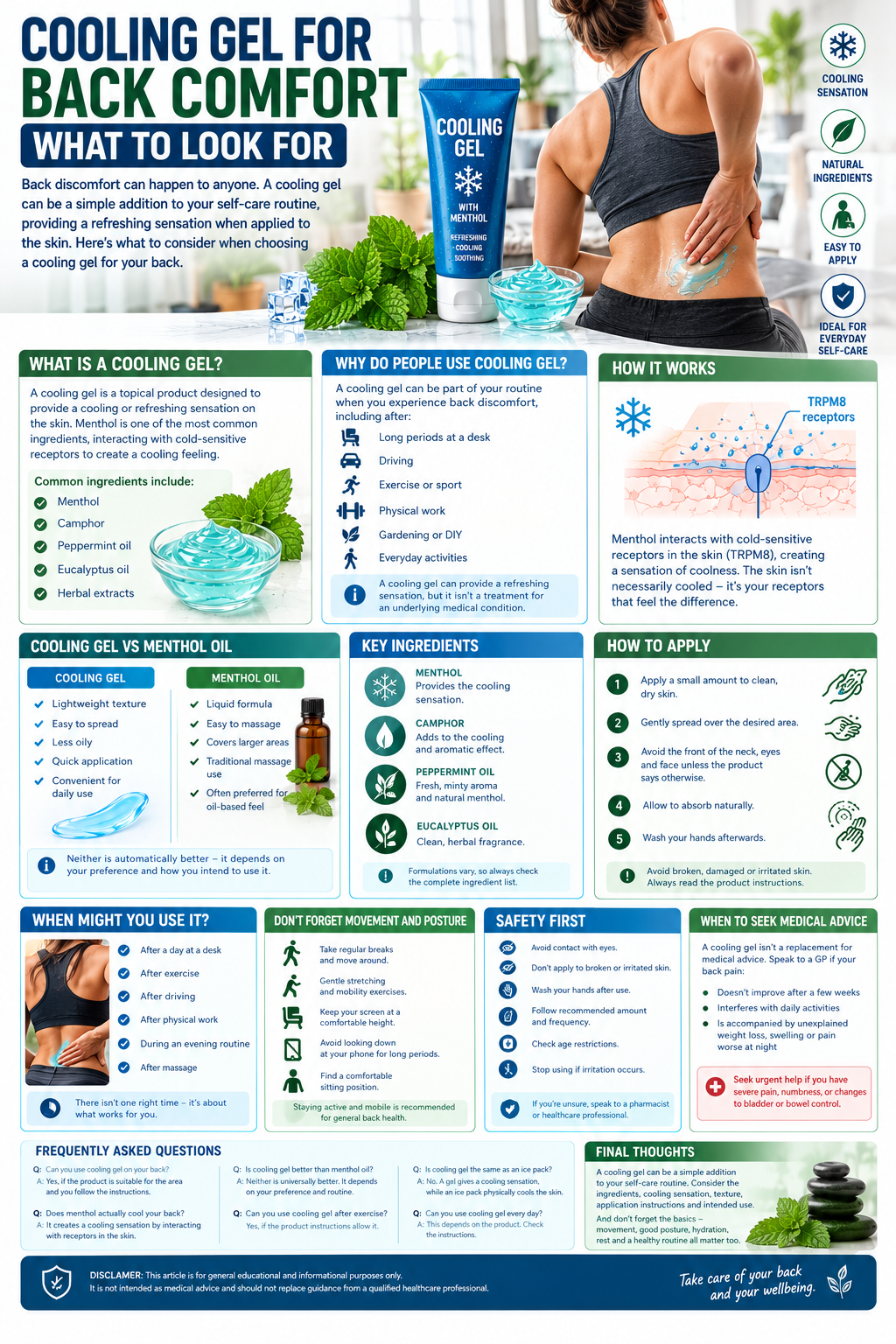
Back discomfort is something many people experience from time to time. Long periods sitting at a desk, driving, exercise, physical work and everyday activities can all leave your back feeling tired or uncomfortable.
A cooling gel can be one option people include in their everyday self-care routine. Products containing ingredients such as menthol are designed to create a refreshing cooling sensation on the skin.
But with so many cooling gels available, what should you actually look for?
In this guide, we’ll explain how cooling gels work, which ingredients you may find in them, how they compare with other topical products and how to use them safely.
Important: Cooling gels are designed for topical use and are not a treatment for an underlying medical condition. If you have persistent, severe or unexplained back pain, seek advice from a healthcare professional.
What Is a Cooling Gel?
A cooling gel is a topical product designed to provide a cooling or refreshing sensation when applied to the skin.
Many cooling gels contain menthol, which interacts with cold-sensitive receptors in the skin and produces the familiar sensation of coolness.
The important distinction is that the cooling sensation does not necessarily mean the skin itself has been significantly cooled. Instead, menthol affects the way the body’s sensory receptors detect temperature.
This makes cooling gels popular for people looking for a refreshing sensation as part of their self-care routine.
Why Do People Use Cooling Gel on Their Back?
There are many reasons someone might choose a cooling gel.
For example, you might want a refreshing sensation after:
- Sitting at a desk for several hours
- A long journey or drive
- Exercise or sport
- Physical work
- Gardening or DIY
- Spending a long time standing
- Everyday activities that leave your back feeling tired
A cooling gel can also be convenient because it can be applied directly to the skin and doesn’t require heating or refrigeration.
The NHS recommends staying active and continuing normal daily activities where possible when dealing with common back pain, rather than remaining in bed for long periods.
A topical cooling product can therefore be considered as one part of a wider self-care routine, rather than a replacement for movement or appropriate medical advice.
How Does Menthol Create a Cooling Sensation?
Menthol is one of the most recognisable ingredients in cooling products.
When applied to the skin, menthol interacts with cold-sensitive receptors known as TRPM8 receptors. This creates a sensation of coolness.
That’s why a menthol-containing gel can feel refreshing even when the surrounding room temperature hasn’t changed.
The strength of this sensation can vary considerably between products depending on:
- The amount of menthol
- Other ingredients
- The formulation
- How much product is applied
- Individual sensitivity
A stronger cooling sensation isn’t necessarily better. The ideal product is one that provides a comfortable sensation for you.
Common Ingredients in Cooling Gels
Although formulations differ between products, you may see several familiar ingredients on the label.
Menthol
Menthol is commonly used to create the characteristic cooling sensation.
It is particularly popular in topical gels, balms and oils designed for a refreshing skin sensation.
Camphor
Camphor is another ingredient sometimes found alongside menthol.
It can contribute to the characteristic cooling or warming sensation of some topical formulations.
Peppermint Oil
Peppermint oil naturally contains menthol and is sometimes included for its fresh, minty aroma and cooling character.
Eucalyptus Oil
Eucalyptus oil may also appear in topical products and can contribute a distinctive fresh aroma.
However, not every cooling gel contains all of these ingredients, so always check the individual product label.
Cooling Gel vs Menthol Oil for Back Use
Cooling gels and menthol oils can have similar ingredients but provide a noticeably different experience.
Cooling gel
A gel may be preferable if you want:
- A lightweight texture
- Easy application
- A product that spreads over the skin
- A less oily finish
- A quick and convenient application
Menthol oil
An oil may be preferable if you want:
- A more traditional topical product
- A formulation suitable for massage
- More lubrication while massaging
- An oil-based texture
Neither format is automatically right for everyone. Your choice can depend on the product’s ingredients, formulation and how you intend to use it.
For more information, see our related guide on [Cooling Gel vs Menthol Oil].
How to Apply Cooling Gel to Your Back
Always follow the instructions supplied with the individual product.
As a general approach:
1. Start with clean, dry skin
Apply the product to clean skin unless the product instructions say otherwise.
2. Use a small amount
You don’t necessarily need a large quantity. Start with the amount recommended on the packaging.
3. Gently spread over the desired area
Apply the gel evenly over the area you want to treat.
Avoid vigorous rubbing if the area is already sensitive or uncomfortable.
4. Wash your hands afterwards
This is particularly important when the product contains strong cooling ingredients.
Avoid touching your eyes or face immediately after application.
5. Follow the product instructions
Different products have different recommended amounts and application frequencies, so always read the label.
When Might You Use Cooling Gel?
There’s no single “best” time to use a cooling gel.
Some people may choose to use one:
After exercise
A cooling sensation can be a refreshing part of a post-exercise routine.
After sitting for a long time
If you’ve spent hours working at a desk or travelling, applying a topical product may be one part of your evening routine.
After physical activity
Gardening, DIY, lifting or other activities can leave your muscles feeling tired.
After driving
Long periods in the same position can make people feel stiff or uncomfortable.
During an evening routine
Some people simply enjoy the refreshing sensation of menthol products after a busy day.
Don’t Forget Movement
A cooling gel shouldn’t be viewed as a substitute for staying active.
For common back pain, the NHS recommends remaining active and continuing everyday activities where possible. It also recommends exercises and stretches where appropriate.
If you’ve been sitting for a long period, try taking regular movement breaks.
Simple habits can include:
- Getting up from your desk regularly
- Taking short walks
- Changing position frequently
- Gentle stretching
- Gradually returning to exercise
- Avoiding long periods of bed rest
If a particular movement makes your symptoms worse, stop and seek appropriate advice.
Cooling Gel vs Heat for Back Discomfort
Cooling products aren’t the only topical or self-care option.
The NHS notes that ice packs can be used to reduce pain and swelling, while heat can help with stiffness or muscle spasms.
Some people therefore prefer cooling sensations, while others find warmth more comfortable.
Your choice may depend on:
- What caused the discomfort
- How the area feels
- Personal preference
- The instructions for the product you’re using
For acute or unexplained pain, particularly following an injury, it’s sensible to seek professional advice if you’re unsure what approach is appropriate.
What Should You Look for When Choosing a Cooling Gel?
When comparing products, don’t focus solely on how “strong” the cooling sensation sounds.
Instead, consider:
1. Ingredients
Check the full ingredient list and look for ingredients you’re comfortable using.
2. Cooling intensity
Some formulations produce a mild refreshing sensation, while others can feel considerably stronger.
3. Texture
A lightweight gel may be more convenient for everyday use than a heavier or oil-based formulation.
4. Application
Look at how much product is recommended and how frequently it can be applied.
5. Skin compatibility
If you have sensitive skin, pay particular attention to the ingredients and follow the manufacturer’s instructions.
6. Intended use
Some products are designed specifically for sports, massage or general everyday use.
Choose a product that matches how you actually intend to use it.
Cooling Gel Safety
Cooling gels are topical products, so they should be used according to their instructions.
In general:
- Do not swallow topical products.
- Avoid contact with the eyes.
- Don’t apply to broken, damaged or irritated skin unless the product specifically says it is suitable.
- Wash your hands after application.
- Stop using the product if significant irritation occurs.
- Follow the recommended amount and frequency.
- Keep products away from children where appropriate.
- Check the label for any age restrictions or other warnings.
If you’re unsure whether a particular topical product is suitable for you, ask a pharmacist or healthcare professional.
When Should You Speak to a Doctor About Back Pain?
A cooling gel isn’t appropriate for every type of back problem.
The NHS advises speaking to a GP if back pain doesn’t improve after a few weeks, interferes with daily activities, or is accompanied by symptoms such as unexplained weight loss, swelling or pain that is worse at night.
You should seek urgent medical help if severe back pain starts suddenly or is getting worse quickly, particularly if you also feel generally unwell.
Call 999 or go to A&E for back pain accompanied by symptoms such as numbness around the genitals or anus, changes in bladder or bowel control, or weakness/numbness affecting both legs.
These symptoms should not be managed simply with a topical cooling product.
Frequently Asked Questions
Can you use cooling gel on your lower back?
Some cooling gels are suitable for application to the lower back, but always check the individual product’s instructions before use.
Does menthol actually cool your back?
Menthol can create a cooling sensation by interacting with cold-sensitive receptors in the skin. This sensation does not necessarily mean that the underlying tissues have been physically cooled.
Is cooling gel suitable after exercise?
A cooling gel can be incorporated into a post-exercise self-care routine if the product instructions allow it. It shouldn’t replace appropriate recovery, hydration, rest and gradual return to activity.
Is cooling gel the same as an ice pack?
No. A cooling gel containing menthol produces a sensory cooling sensation, while an ice or cold pack physically transfers cold to the skin. They are different products.
Can I use cooling gel every day?
This depends on the individual formulation. Always follow the manufacturer’s recommended frequency and application instructions.
Is cooling gel better than warming gel?
There isn’t one option that is universally suitable for everyone. Cooling and warming products provide different sensations, so consider the formulation, intended use and your personal preference.
For more information please refer to our other blog posts:
- Why Is Menthol Used in Cooling Gels?
- Best Cooling Gels for Muscle Comfort in the UK
- Cooling Gel vs Warming Gel: Which Should You Choose?
- Cooling Gel for Neck and Shoulder Comfort: What to Look For
- Cooling Gel vs Menthol Oil
- What Is Kwan Loong Medicated Oil?
Final Thoughts
A cooling gel can be a simple addition to an everyday self-care routine, particularly if you enjoy the refreshing sensation provided by ingredients such as menthol.
When choosing a product, look beyond the packaging and consider the ingredients, cooling intensity, texture, application instructions and intended use.
Most importantly, remember that a topical cooling product is only one part of looking after your back. Staying active, changing positions regularly and gradually building movement into your routine can also be important for general back health.
If your back pain is persistent, severe, worsening or accompanied by concerning symptoms, seek advice from a healthcare professional rather than relying on a topical product.
Disclaimer
This article is provided for general informational and educational purposes only. It is not intended to provide medical advice, diagnose or treat any medical condition, or replace advice from a qualified healthcare professional.