
Cooling Gel vs Warming Gel: Which Should You Choose?
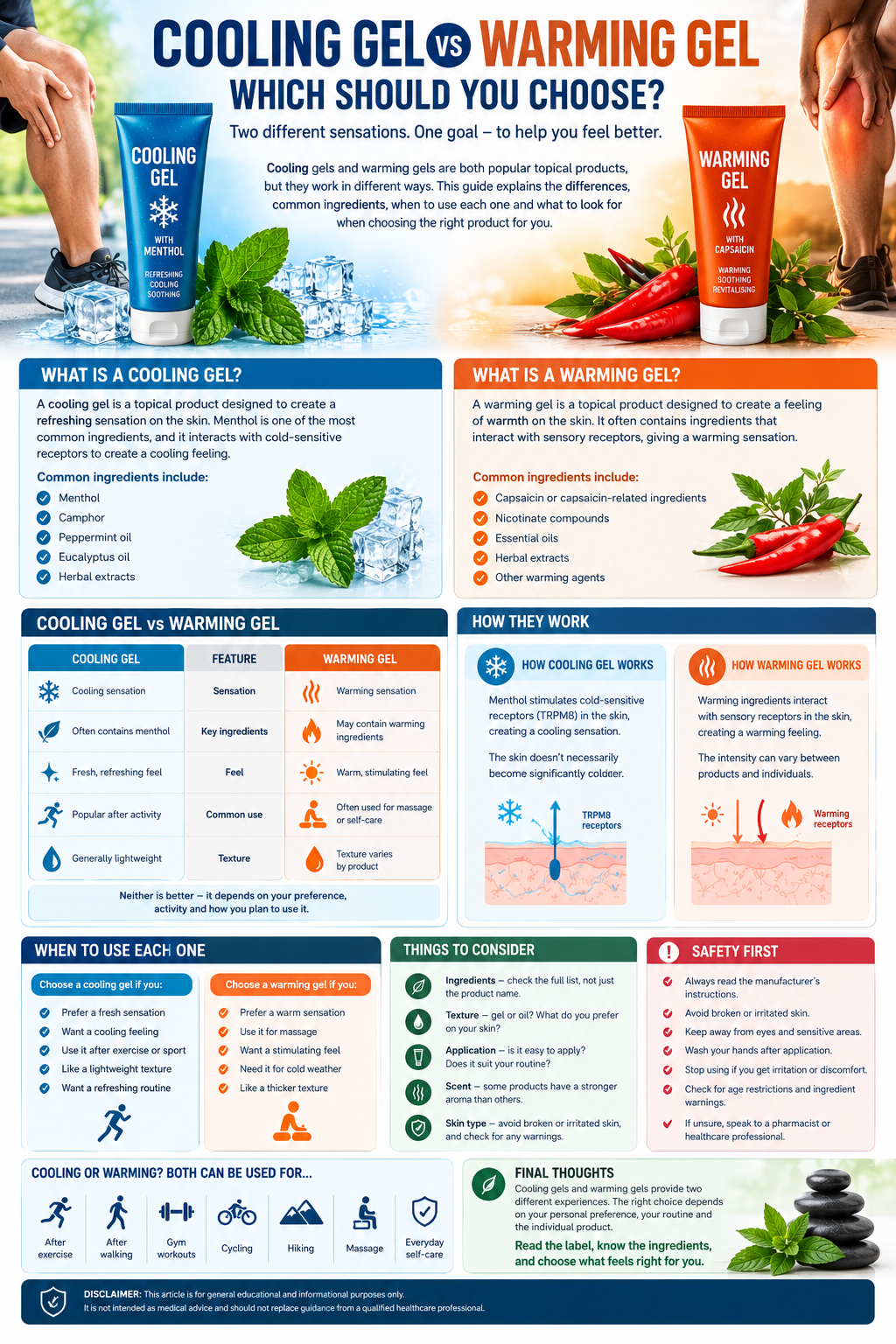
When choosing a topical product for your self-care routine, you may come across both cooling gels and warming gels.
Although both are designed to provide a noticeable sensation when applied to the skin, they offer very different experiences.
Cooling gels are generally associated with a fresh, cooling sensation, while warming gels are formulated to create a feeling of warmth.
So, which should you choose?
The answer depends on your personal preference, the type of activity you’re doing and the product’s specific instructions.
In this guide, we’ll explain the differences between cooling and warming gels and what to consider when choosing between them.
What Is a Cooling Gel?
A cooling gel is a topical product formulated to create a refreshing sensation on the skin.
Menthol is one of the most common ingredients found in cooling gels. It interacts with cold-sensitive receptors in the skin, creating the familiar sensation of coolness.
Other ingredients may include:
- Camphor
- Peppermint oil
- Eucalyptus oil
- Herbal extracts
- Other botanical ingredients
Cooling gels are commonly used as part of everyday self-care and post-exercise routines.
What Is a Warming Gel?
A warming gel is a topical product designed to create a feeling of warmth when applied to the skin.
Depending on the formulation, warming products can contain ingredients such as:
- Capsaicin or capsaicin-related ingredients
- Nicotinate compounds
- Essential oils
- Herbal extracts
- Other warming agents
The exact ingredients vary considerably between products.
Because formulations differ, always check the label before using a warming gel.
Cooling Gel vs Warming Gel: What’s the Difference?
The simplest difference is the sensation they are designed to produce.
| Cooling Gel | Warming Gel |
|---|---|
| Creates a cooling sensation | Creates a warming sensation |
| Often contains menthol | May contain warming ingredients |
| Fresh, refreshing feel | Warm, stimulating feel |
| Popular after physical activity | Often used as part of massage or self-care |
| Generally lightweight | Texture varies by product |
Neither type is automatically better than the other.
Your choice comes down to what type of sensation you prefer and how you intend to use the product.
How Does Cooling Gel Work?
Cooling gels frequently contain menthol.
When menthol is applied to the skin, it interacts with cold-sensitive receptors, particularly TRPM8 receptors.
This produces a sensation of coolness.
Importantly, the sensation of cooling does not necessarily mean that the skin itself has been significantly cooled.
This is why a menthol gel can feel cold even when the product is at room temperature.
How Does Warming Gel Work?
Warming gels use different ingredients to produce a sensation of heat or warmth.
Depending on the formulation, these ingredients can interact with sensory receptors in the skin, creating a warming feeling.
The intensity can vary significantly between products.
A product that feels strongly warming to one person may feel relatively mild to another.
When Might You Choose a Cooling Gel?
Cooling gels can be particularly appealing when you want a fresh and refreshing sensation.
People commonly incorporate cooling gels into routines such as:
After Exercise
A cooling gel can be part of a post-exercise self-care routine.
After Walking or Sport
Some people enjoy a refreshing topical sensation after being active.
After Physical Work
A cooling product can be convenient after a physically demanding day.
During Everyday Self-Care
You don’t need to be an athlete to use a cooling gel. It can simply be part of your personal wellbeing routine.
When Might You Choose a Warming Gel?
Warming products can appeal to people who prefer a warm sensation rather than a cooling one.
They are commonly used as part of:
- Massage routines
- Warm-up routines
- Cold-weather self-care
- General topical wellbeing
- Post-activity routines
However, always check the specific product instructions, as recommended uses vary between formulations.
Cooling Gel Before Exercise
Whether you should use a cooling gel before exercise depends on the individual product and your personal routine.
A cooling sensation isn’t the same thing as physically warming up your muscles.
If you’re preparing for exercise, a proper warm-up involving gradual movement is generally more appropriate than relying on a topical product.
A warm-up can include:
- Light walking
- Gentle mobility exercises
- Gradually increasing activity intensity
- Activity-specific movements
Always follow the manufacturer’s instructions for any topical product.
Cooling Gel After Exercise
Cooling gels are commonly incorporated into post-exercise self-care routines.
The refreshing sensation of menthol can be appealing after activities such as:
- Running
- Cycling
- Walking
- Gym workouts
- Hiking
- Football and other sports
Remember that a topical cooling sensation isn’t the same as treating an injury or guaranteeing faster recovery.
Proper rest, hydration, nutrition and sensible training remain important.
Warming Gel Before Exercise
Some people use warming products as part of their pre-exercise routine.
However, a warming gel should not replace a proper physical warm-up.
If you’re preparing for exercise, gradually increasing your activity level is an important part of preparing your body for movement.
Always use warming products according to the manufacturer’s instructions.
Cooling Gel or Warming Gel for Massage?
Both can be used in different self-care routines, depending on the formulation.
A cooling gel can provide a refreshing sensation during or after massage.
A warming product can provide a contrasting warm sensation.
If you’re using a product specifically for massage, check that the manufacturer recommends it for that purpose.
Which One Should You Choose?
Consider what experience you’re looking for.
Choose a Cooling Gel If You Prefer:
- A fresh sensation
- A cooling feeling
- Menthol-based formulations
- Lightweight topical products
- A refreshing post-exercise routine
Consider a Warming Gel If You Prefer:
- A warm sensation
- Warming formulations
- Massage routines
- A warming feeling during colder weather
- Products designed specifically for that purpose
There’s no universally “best” option.
Check the Ingredients
Don’t choose a product based purely on whether it says “cooling” or “warming.”
Look at the ingredients.
For cooling products, you may see:
- Menthol
- Camphor
- Peppermint oil
- Eucalyptus oil
For warming products, you may see:
- Capsaicin-related ingredients
- Nicotinate compounds
- Essential oils
- Herbal extracts
Different ingredients produce different experiences, so reading the label is important.
Cooling and Warming Sensations Can Vary
The sensation you experience can depend on several factors, including:
- Product formulation
- Ingredient concentration
- Where the product is applied
- Amount applied
- Individual sensitivity
- Skin condition
This means two products labelled as “cooling” can feel completely different.
The same applies to warming gels.
A stronger sensation doesn’t automatically mean a better product.
Important Safety Considerations
Always read the manufacturer’s instructions before using a cooling or warming gel.
Avoid applying topical products to:
- Broken skin
- Cuts
- Irritated skin
- Sensitive areas
- Around the eyes
Wash your hands after application and avoid transferring the product to your eyes or other sensitive areas.
If you experience significant irritation or an unpleasant reaction, stop using the product.
If you’re unsure whether a particular product is appropriate for you, speak to a pharmacist or healthcare professional.
Can You Use Cooling and Warming Products Together?
Don’t assume that cooling and warming products can be layered or used one immediately after another.
Some formulations may cause excessive irritation when combined.
Always follow the individual manufacturer’s instructions and check whether combining products is recommended.
If you’re unsure, ask a pharmacist or healthcare professional.
Cooling Gel vs Warming Gel for Everyday Self-Care
Ultimately, choosing between a cooling and warming gel comes down to personal preference.
You might prefer a cooling product because you enjoy the refreshing sensation of menthol.
Someone else may prefer a warming product because they enjoy a warm sensation during massage.
There isn’t a single product that’s right for everyone.
Don’t Forget the Basics
Topical products should be considered one part of a wider self-care routine.
Other useful habits include:
- Regular movement
- Gentle stretching
- Proper warm-ups
- Gradually increasing exercise intensity
- Adequate rest
- Staying hydrated
- Getting enough sleep
If you’re experiencing persistent or severe pain, don’t rely on topical products alone. Consider seeking appropriate professional advice.
Frequently Asked Questions
Is Cooling Gel Better Than Warming Gel?
Not necessarily. They provide different sensations and are suited to different preferences and routines.
Is Cooling Gel Good After Exercise?
Cooling gels are commonly used as part of post-exercise self-care because they provide a refreshing cooling sensation.
Is Warming Gel Good Before Exercise?
Some people use warming products as part of their routine before activity, but they should not replace a proper physical warm-up.
Can Cooling Gel and Warming Gel Be Used Together?
Don’t assume they can. Check the manufacturer’s instructions before combining topical products.
Does Cooling Gel Actually Make Your Muscles Cold?
Menthol primarily creates a sensation of cooling by interacting with cold-sensitive receptors in the skin. The sensation doesn’t necessarily mean the underlying tissue has been significantly cooled.
Which Is Better for Massage?
Either may be suitable depending on the formulation and your preference. Always check whether the specific product is intended for massage.
Final Thoughts
Cooling gels and warming gels provide two very different topical experiences.
Cooling gels, particularly those containing menthol, are associated with a fresh and refreshing sensation.
Warming gels are formulated to create a sensation of warmth and may contain ingredients specifically chosen for that purpose.
The right choice depends on your preferences, your routine and the individual product.
Rather than choosing a product simply because it feels stronger, look at the ingredients, read the instructions and choose a formulation that’s appropriate for how you intend to use it.
For more information please refer to our other blog posts:
- Best Cooling Gels for Muscle Comfort in the UK
- Why Is Menthol Used in Cooling Gels?
- Cooling Gel vs Menthol Oil
- Menthol vs Camphor: What’s the Difference?
- Peppermint Oil vs Menthol: What’s the Difference?
- What Does Camphor Do in Topical Products?
- What Does Eucalyptus Oil Do in Topical Products?
- What Is Wintergreen Oil? Uses, Benefits and Safety Guide
Disclaimer
This article is for general educational and informational purposes only. It is not intended as medical advice and should not replace guidance from a qualified healthcare professional.
One Response