
Cooling Gel vs Menthol Oil for Tired Legs
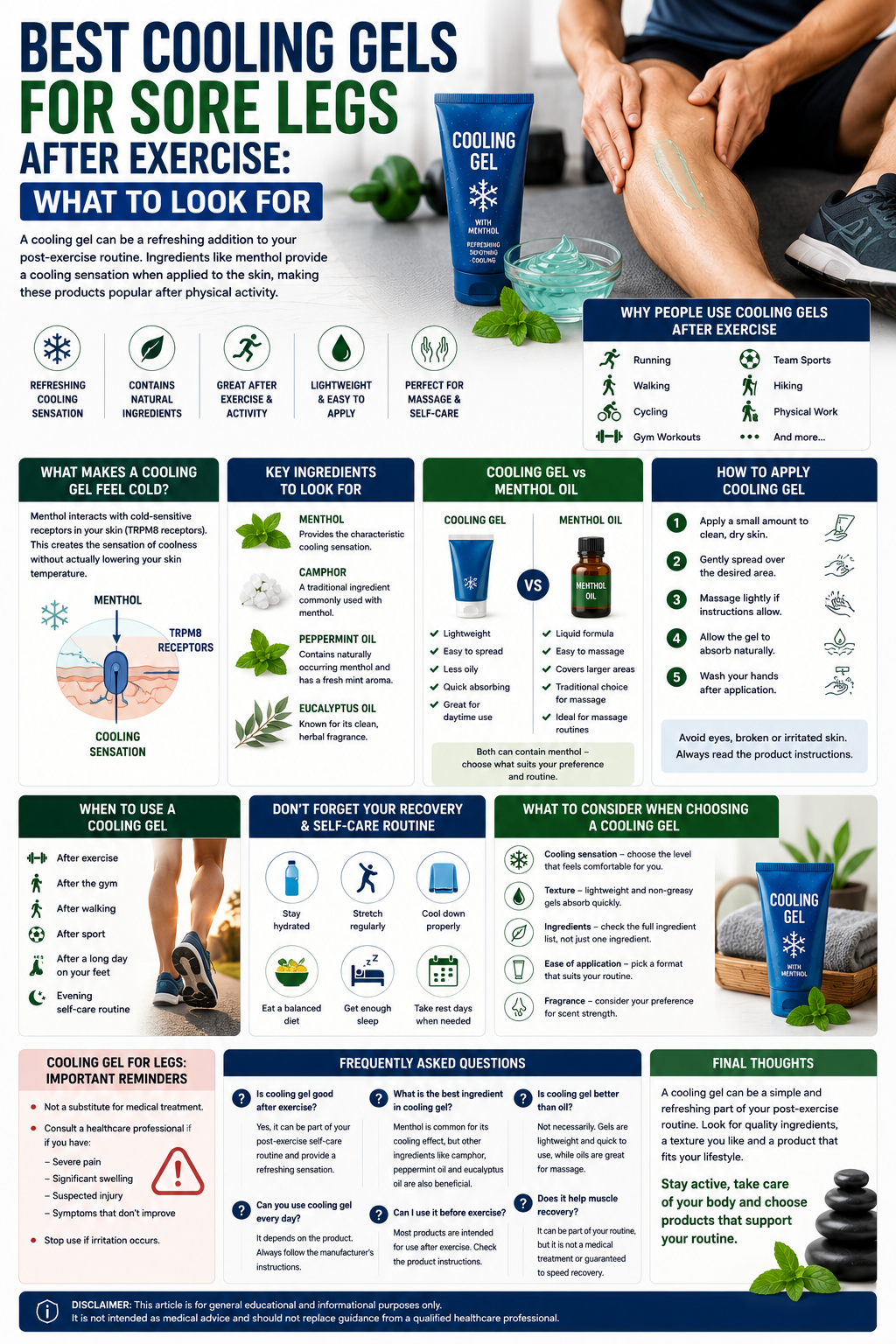
Both cooling gels and menthol oils can be used as part of a self-care routine, but they have different textures and application experiences.
Cooling Gel
Cooling gels are generally:
- Lightweight
- Easy to spread
- Less oily
- Convenient for quick application
- Suitable for people who prefer a fast-absorbing texture
Menthol Oil
Menthol oils are:
- Liquid
- Easy to massage
- Useful for covering larger areas
- Popular for traditional massage routines
- Often preferred by people who enjoy an oil-based product
If you want something quick and lightweight, a gel may be more convenient.
If you want to spend time massaging your legs, an oil may be preferable.
There’s no universal right choice.
How to Choose a Cooling Gel for Your Legs
When comparing products, consider the following.
1. Cooling Sensation
Different products can provide different levels of cooling.
Some people prefer a mild refreshing sensation, while others prefer something more noticeable.
A stronger cooling sensation isn’t necessarily better. Choose something that feels comfortable for you.
2. Texture
Consider how you want the product to feel on your skin.
A lightweight gel may be preferable if you don’t want an oily residue after application.
3. Ingredients
Look at the complete ingredient list rather than focusing on one ingredient.
Menthol, camphor, peppermint oil and eucalyptus oil are all commonly found in topical cooling products.
4. Ease of Application
For tired legs, you may want something that’s easy to apply without making a mess.
Tubes and pump bottles can both be convenient depending on your preferences.
5. Fragrance
Ingredients such as menthol, peppermint and eucalyptus can produce distinctive aromas.
If you’re sensitive to strong fragrances, check the ingredient list before purchasing.
How to Apply Cooling Gel to Your Legs
Always follow the manufacturer’s instructions for your particular product.
For a typical topical cooling gel, application may involve:
- Apply a small amount to clean, dry skin.
- Gently spread it over the desired area.
- Massage lightly if the product instructions allow.
- Allow the gel to absorb naturally.
- Wash your hands after application.
Avoid applying topical products to broken, irritated or damaged skin.
Take care to avoid contact with your eyes and other sensitive areas.
When Should You Apply Cooling Gel?
There isn’t one specific time that’s right for everyone.
Many people choose to apply a cooling product as part of their post-exercise routine.
For example:
After Running
A cooling gel can form part of your post-run self-care routine.
After the Gym
You may choose to apply it after completing your workout and showering.
After a Long Walk
A cooling sensation can feel refreshing after spending several hours on your feet.
After Sport
Cooling products are commonly included in post-sport routines.
At the End of a Busy Day
You don’t have to be an athlete to enjoy a cooling topical product. It can simply be part of an everyday self-care routine.
Don’t Forget the Rest of Your Recovery Routine
A cooling gel is only one small part of looking after yourself after exercise.
Other useful habits include:
- Drinking enough fluids
- Gentle stretching
- Gradually cooling down after exercise
- Getting enough sleep
- Taking rest days when appropriate
- Eating a balanced diet
- Avoiding sudden increases in training intensity
Listening to your body is also important.
If something feels significantly different from normal post-exercise tiredness, don’t simply rely on a topical product.
Cooling Gel for Legs: What About Persistent Pain?
It’s important to distinguish between normal post-exercise tiredness and an injury or ongoing pain.
A cooling gel can provide a refreshing topical sensation, but it isn’t intended to diagnose or treat the underlying cause of persistent pain.
Consider speaking to a healthcare professional if you experience:
- Severe pain
- Significant swelling
- Difficulty walking
- A suspected injury
- Symptoms that don’t improve
- Repeated or unexplained pain
A topical product should complement sensible self-care rather than replace appropriate medical advice.
Can You Use Cooling Gel Every Day?
This depends on the individual product.
Different formulations have different instructions regarding frequency and duration of use.
If you’re planning to use a cooling gel regularly, check:
- The manufacturer’s instructions
- Recommended frequency
- Ingredient warnings
- Age restrictions
- Any precautions on the packaging
Stop using the product if it causes irritation or an unpleasant reaction.
Frequently Asked Questions
Is Cooling Gel Good After Exercise?
Cooling gels are commonly used as part of post-exercise self-care because they can provide a refreshing cooling sensation on the skin.
What Is the Best Ingredient in Cooling Gel?
There isn’t one ingredient that’s best for everyone. Menthol is commonly used because of its cooling sensation, while ingredients such as camphor, peppermint and eucalyptus may also be included.
Is Cooling Gel Better Than Oil?
It depends on your preference. Gels are generally lightweight and convenient, while oils can be particularly suitable for massage.
Can I Put Cooling Gel on My Legs After Running?
If the product is intended for topical use on the skin, follow the manufacturer’s application instructions. Avoid broken or irritated skin.
Does Cooling Gel Help Muscle Recovery?
Cooling gels can be part of a post-exercise self-care routine and provide a refreshing sensation. However, they shouldn’t be presented as a replacement for proper recovery, medical treatment or professional advice.
Final Thoughts
A cooling gel can be a simple addition to a post-exercise or everyday self-care routine.
When choosing one for your legs, consider the ingredients, cooling sensation, texture, fragrance and application method rather than simply choosing the product with the strongest cooling effect.
Menthol is one of the most common ingredients in cooling gels, while camphor, peppermint oil and eucalyptus oil are also frequently found in topical formulations.
Most importantly, remember that a cooling gel is just one part of looking after your body. Regular movement, sensible exercise, hydration, rest and appropriate recovery are all important parts of a healthy routine.
For more information please refer to our other blog posts:
I’d link this post naturally to:
- Best Cooling Gels for Muscle Comfort in the UK
- Why Is Menthol Used in Cooling Gels?
- Cooling Gel vs Menthol Oil
- Menthol vs Camphor: What’s the Difference?
- Peppermint Oil vs Menthol: What’s the Difference?
- What Does Eucalyptus Oil Do in Topical Products?
- What Is Wintergreen Oil?
- How to Apply Menthol Oil Properly
- What Is Kwan Loong Medicated Oil?
Disclaimer
This article is for general educational and informational purposes only. It is not intended as medical advice and should not replace guidance from a qualified healthcare professional.