
Camphor in Medicated Oils: Uses, Ingredients and Safety Guide
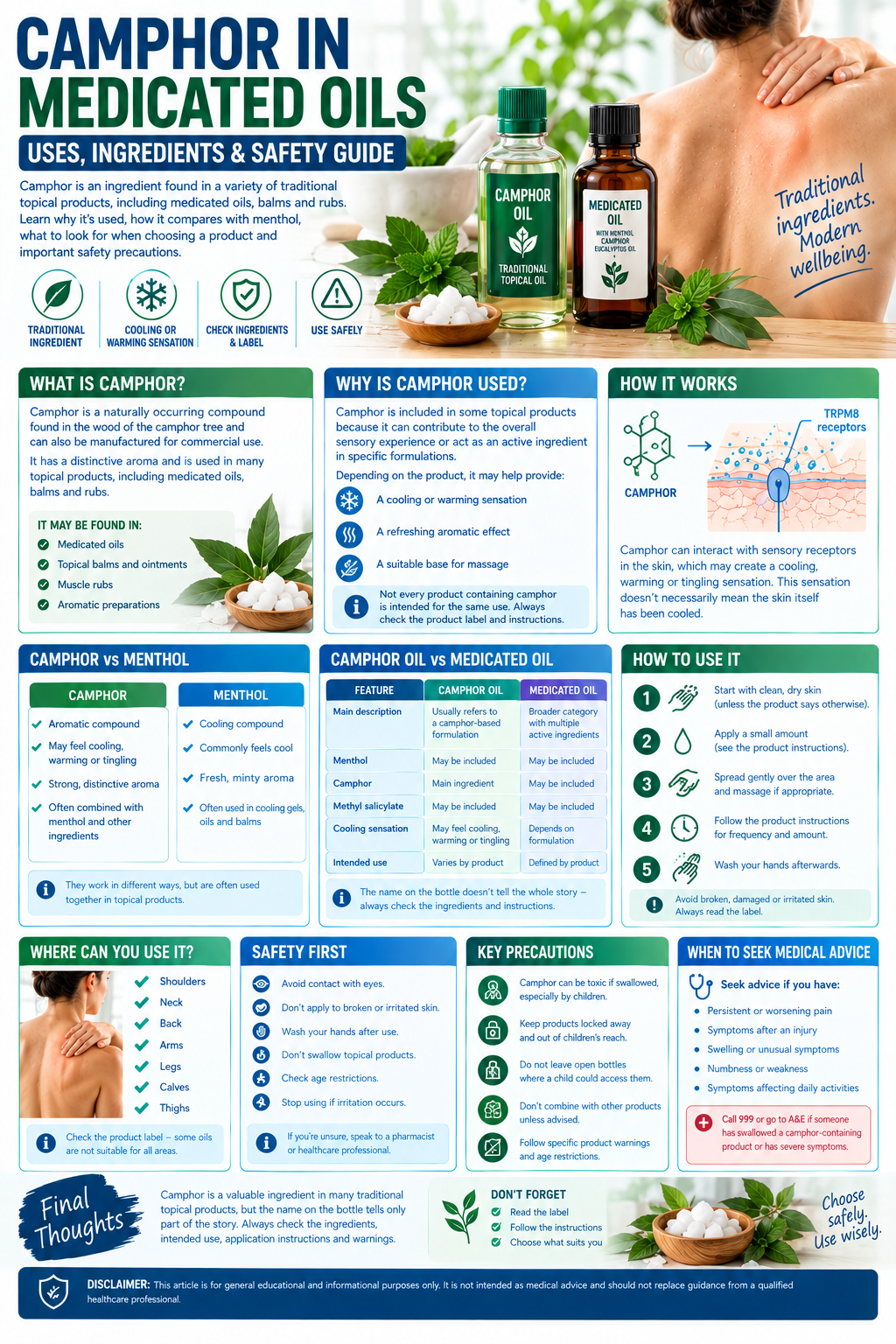
Camphor is an ingredient found in a variety of traditional topical products, including medicated oils, balms and rubs. It is often combined with ingredients such as menthol and eucalyptus oil to create distinctive cooling, warming or aromatic sensations.
If you’ve ever looked at the ingredients on a bottle of medicated oil, you may have noticed camphor listed alongside other familiar ingredients.
But what exactly is camphor, why is it used in topical products, and what should you know before using a product that contains it?
In this guide, we’ll explore camphor’s role in medicated oils, how it differs from menthol, what to look for when choosing a product and the safety precautions you should always follow.
Important: Camphor-containing products vary considerably in their formulation and intended use. This article is for general educational purposes only. Always check the individual product label and follow the manufacturer’s instructions.
What Is Camphor?
Camphor is a naturally occurring chemical compound historically obtained from the wood of the camphor tree (Cinnamomum camphora). It can also be manufactured for use in commercial products.
It has a distinctive, strong aroma and is used in various applications, including certain topical preparations.
In consumer products, camphor may be found in:
- Medicated oils
- Topical balms and ointments
- Muscle rubs
- Some aromatic preparations
- Certain products intended for specific topical uses
Its role depends on the formulation. In some products, camphor is included as an active ingredient; in others, it may contribute to the product’s overall sensory characteristics.
It is important to distinguish between a finished topical product containing a controlled formulation of camphor and concentrated camphor oil or other preparations that may not be suitable for direct application to the skin.
These products should never automatically be treated as interchangeable.
Why Is Camphor Used in Medicated Oils?
Camphor has a long history of use in traditional topical preparations.
Modern products may combine it with other ingredients to create a particular sensory experience or to serve a specified purpose.
Depending on the formulation, camphor-containing topical products may be marketed for uses such as:
- Providing a cooling or warming sensation
- Use as part of a topical massage routine
- Temporary relief of certain minor aches and pains, where the product is specifically formulated and authorised for that purpose
Not every camphor-containing product is intended for all these uses. Always check the product’s stated purpose rather than assuming that the presence of camphor guarantees a particular effect.
The formulation, concentration and other ingredients all matter.
How Does Camphor Feel on the Skin?
Camphor can produce a noticeable sensory response when included in certain topical preparations.
Depending on the formulation, you may experience a cooling, warming or tingling sensation.
This is one reason camphor is sometimes combined with menthol in medicated oils and topical rubs.
However, a noticeable sensation does not necessarily mean that a product is more effective. Strong sensations can also be uncomfortable or indicate irritation.
If a product causes significant burning, redness or discomfort, stop using it and follow the advice on its packaging.
Camphor vs Menthol: What’s the Difference?
Camphor and menthol are different ingredients, although they are sometimes used together.
Menthol is particularly well known for producing a cooling sensation by interacting with cold-sensitive receptors in the skin.
Camphor can produce a different sensory response, depending on its concentration and the formulation in which it is used.
Here’s a simple comparison:
| Feature | Camphor | Menthol |
|---|---|---|
| Ingredient type | Aromatic chemical compound | Cooling compound |
| Sensory experience | May feel cooling, warming or tingling | Commonly associated with coolness |
| Aroma | Strong, distinctive scent | Fresh, minty scent |
| Use in topical products | Found in some oils, balms and rubs | Found in many cooling gels, oils and balms |
| Combined formulations | May be combined with menthol | May be combined with camphor |
| Safety | Depends on concentration and product | Depends on concentration and product |
Neither ingredient is automatically better than the other. Their suitability depends on the particular formulation and its intended use.
For more information, see our related guide, [Why Is Menthol Used in Cooling Gels?]
Camphor in Traditional Medicated Oils
Some traditional medicated oils contain a combination of camphor, menthol and other aromatic ingredients.
Kwan Loong Medicated Oil is one example of a topical product for which ingredient information and directions should be checked on the relevant packaging.
The important point is that traditional medicated oils are not all formulated in the same way. Ingredients, concentrations, intended uses and warnings can vary between products and markets.
When comparing products, look at the actual ingredient list rather than relying on the name or traditional reputation of the product.
If you’re interested in learning more about a particular product, read our dedicated guide:
[What Is Kwan Loong Medicated Oil?]
Camphor vs Eucalyptus Oil
Camphor and eucalyptus oil are also sometimes found in related topical preparations, but they are not the same ingredient.
Camphor is a specific chemical compound. Eucalyptus oil is an essential oil obtained from eucalyptus plants and contains a mixture of naturally occurring compounds.
They have different chemical compositions and safety considerations.
A product containing both ingredients may have a different aroma, formulation and intended use from a product containing only camphor.
This is another reason to read the full product label before use.
What Should You Look for When Choosing a Camphor-Containing Product?
If you’re comparing topical oils, balms or rubs, consider the following factors.
1. The full ingredient list
Check which ingredients are present and whether any are unsuitable for you.
Don’t assume that two products with similar names contain the same ingredients.
2. The intended use
Look for clear instructions explaining what the product is intended for and where it may be applied.
3. The formulation
An oil, balm, cream and gel can feel quite different on the skin. Choose a product whose format suits your preferences and intended use.
4. Application instructions
Check the recommended amount, application frequency and any restrictions on how the product should be used.
5. Safety warnings
Pay particular attention to age restrictions, warnings about damaged skin and instructions regarding sensitive areas.
6. Product information and labelling
Choose products with clear ingredient information, directions and manufacturer details.
For UK consumers, it is sensible to buy from a reputable retailer and check that the product is appropriately labelled for the market in which it is sold.
How Should You Use a Camphor-Containing Topical Product?
Always follow the instructions for the exact product you have purchased.
General precautions include:
- Read the label first. Confirm that the product is suitable for your intended use.
- Use only the recommended amount. Do not assume that applying more will provide a better result.
- Apply only to permitted areas. Follow the product’s directions regarding where it may be used.
- Avoid the eyes and mucous membranes. Camphor-containing products can cause irritation.
- Do not apply to broken or damaged skin unless the product specifically instructs you otherwise.
- Wash your hands after application and avoid transferring the product to your eyes or mouth.
- Store the product securely and keep it out of children’s reach.
Do not combine camphor-containing products with external heat, tight coverings or other topical preparations unless the product instructions specifically permit this. Certain combinations can increase the risk of skin irritation or burns.
Camphor Safety: Important Precautions
Camphor must be treated with care.
Although it is used in some properly formulated topical products, it can be toxic if swallowed. Accidental ingestion is particularly dangerous for young children and can cause serious effects, including seizures. NHS England has highlighted the risk of severe poisoning from accidental ingestion of camphor oil.
Never swallow a topical camphor product or use a product internally unless it has specifically been formulated and labelled for that route of use.
Additional precautions include:
- Keep camphor products locked away or securely stored out of children’s reach.
- Never leave an open bottle where a child could access it.
- Do not assume that a product is safe simply because it is described as natural or traditional.
- Do not apply concentrated camphor oil directly to the skin unless the product is specifically formulated and labelled for that use.
- Stop using a product if significant irritation develops.
- Seek advice from a pharmacist if you are unsure whether a product is suitable for you.
If someone swallows a camphor-containing product, seek urgent medical advice. The NHS advises calling 999 or going to A&E if you think someone has swallowed a potentially harmful substance.
Is Camphor Oil the Same as a Medicated Oil?
No, not necessarily.
The term camphor oil may refer to different types of preparations, while medicated oil is a broader description for topical products formulated for a particular purpose.
A medicated oil may contain camphor alongside menthol, eucalyptus oil or other ingredients.
A product described as camphor oil may have a different concentration or formulation entirely.
This distinction matters because concentrated preparations can carry different risks from finished products designed for specific topical uses.
Always check the exact product name, ingredients, intended use and warnings before applying it.
Frequently Asked Questions
What is camphor used for in medicated oils?
Camphor is used in some topical formulations to contribute to their sensory effects or to serve as an active ingredient in products intended for specific uses. Its role depends on the individual formulation.
Does camphor create a cooling sensation?
Camphor can produce a noticeable sensory response, which may feel cooling, warming or tingling depending on the formulation. It is not identical to menthol.
Can camphor and menthol be used together?
Some commercially formulated topical products contain both ingredients. However, you should not mix separate products or apply them together unless their instructions permit it.
Is camphor oil safe to apply directly to the skin?
This depends on the specific preparation and its concentration. Do not assume that concentrated camphor oil is suitable for direct application. Use only products specifically formulated and labelled for the intended purpose.
Can camphor-containing products be swallowed?
No. Products intended for topical use should not be swallowed. Camphor can cause serious poisoning, particularly in children.
Is camphor a natural ingredient?
Camphor occurs naturally in certain plants and can also be manufactured. Whether an ingredient is natural does not, by itself, establish that a product is safe.
Does every medicated oil contain camphor?
No. Medicated oils have different formulations. Always check the ingredient list of the individual product.
for more information please refer to our other blog posts:
- What Is Kwan Loong Medicated Oil?
- Menthol Oil vs Medicated Oil: What’s the Difference?
- Menthol Oil for Massage: What to Look For and How to Use It
- What Is Wintergreen Oil? Uses, Benefits and Safety Guide
- Why Is Menthol Used in Cooling Gels?
- Cooling Gel vs Menthol Oil
Final Thoughts
Camphor is an ingredient found in a variety of traditional topical preparations, including some medicated oils, balms and rubs.
It may be combined with menthol and other ingredients to create a particular sensory experience or form part of a product designed for a specific use.
However, the name on the bottle tells only part of the story.
When choosing a camphor-containing product, consider the full ingredient list, intended use, formulation, application instructions and safety warnings.
Most importantly, remember that camphor-containing products are not interchangeable, and concentrated camphor preparations can be dangerous if used incorrectly.
Always follow the manufacturer’s instructions and store these products securely away from children.
Disclaimer
This article is provided for general informational and educational purposes only. It is not intended to provide medical advice, diagnose or treat any medical condition, or replace advice from a qualified healthcare professional.
Camphor-containing oils, medicated oils and other topical products vary in their ingredients, concentrations, intended uses and safety information. Always read the product label and packaging carefully and follow the manufacturer’s instructions before use.
Camphor can be toxic if swallowed, particularly by young children. Keep all camphor-containing products securely stored out of children’s reach. If you are unsure whether a product is suitable for you, speak to a pharmacist or other qualified healthcare professional.
If you experience persistent, severe, worsening or unexplained symptoms, seek appropriate medical advice rather than relying on a topical product.
Do not use this information as a substitute for professional medical advice, diagnosis or treatment.