
Eucalyptus Oil in Topical Products: Uses, Benefits and Safety Guide
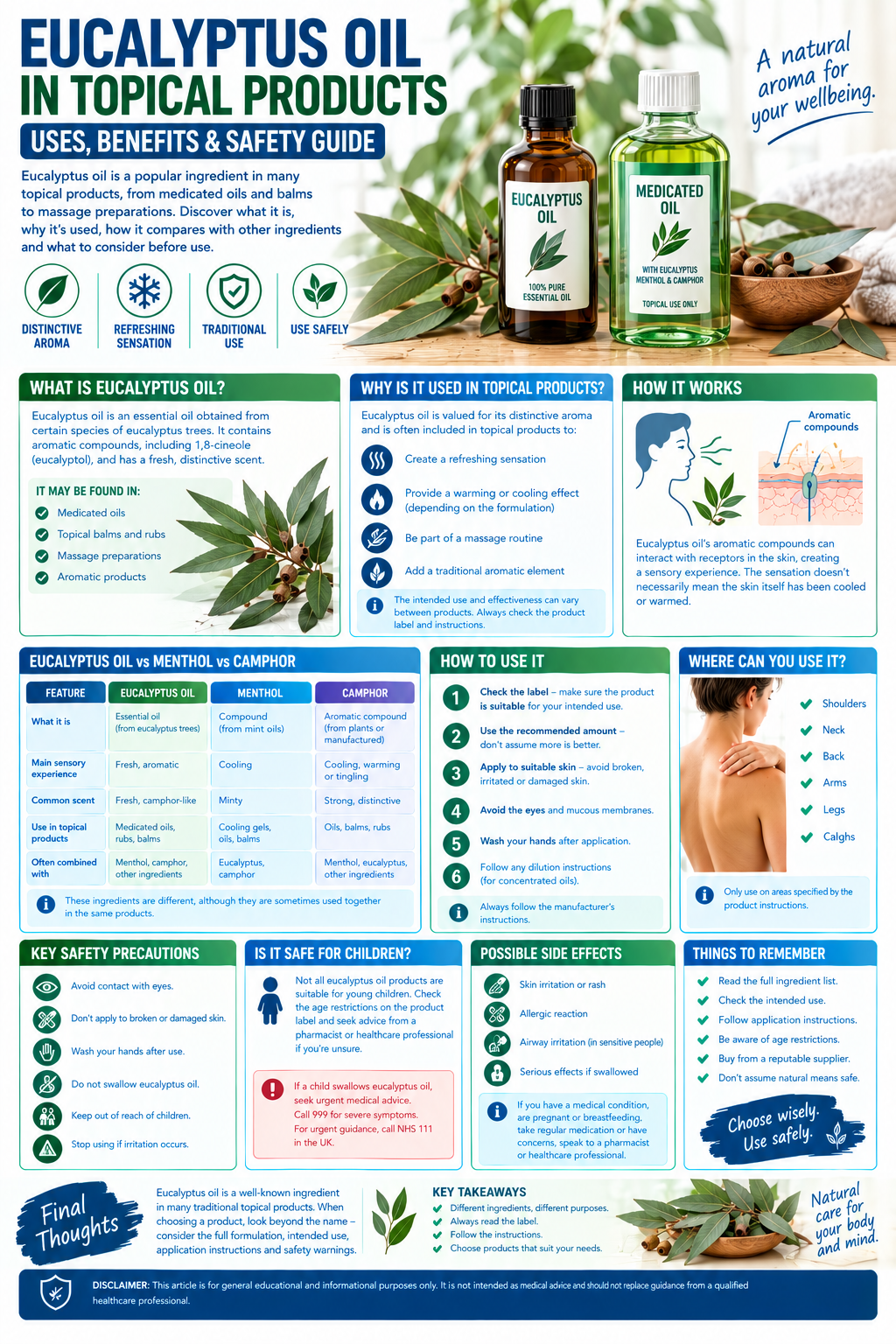
Eucalyptus oil is a popular aromatic ingredient found in a variety of products, including medicated oils, massage preparations, balms and rubs. Recognised for its distinctive, fresh scent, it has a long history of use in traditional products designed to provide a refreshing sensation and support everyday wellbeing routines.
But what exactly is eucalyptus oil, why is it used in topical products, and what should you know before choosing a product containing this ingredient?
In this guide, we explore eucalyptus oil, its role in medicated oils, how it compares with ingredients such as menthol and camphor, and the important safety precautions to consider.
Please remember: Natural ingredients are not automatically safe for every person or every use. The suitability of a product depends on its formulation, concentration, intended use and instructions.
What Is Eucalyptus Oil?
Eucalyptus oil is an essential oil obtained from certain species of eucalyptus trees. These trees are native to Australia, although eucalyptus species are now grown in many parts of the world.
The oil contains aromatic compounds, including 1,8-cineole, also known as eucalyptol. Its composition can vary according to the eucalyptus species and how the oil is produced.
Eucalyptus oil is valued for its characteristic fresh, camphor-like aroma. It is used in various products, including certain medicinal preparations, topical rubs and aromatic formulations.
In topical products, eucalyptus oil may be combined with other ingredients to create a particular scent, skin sensation or overall product experience.
It is important to distinguish between pure eucalyptus essential oil and a finished product formulated for application to the skin. They are not interchangeable, and pure essential oil should not be applied directly to the skin unless the product’s instructions specifically establish a safe method of use.
Why Is Eucalyptus Oil Used in Medicated Oils?
Eucalyptus oil appears in some traditional medicated oils, balms and massage products because of its distinctive aroma and established history of use in topical preparations.
Depending on the formulation, a product containing eucalyptus oil may be intended to provide a warming sensation, a refreshing aromatic experience or temporary relief from certain minor symptoms.
The European Medicines Agency has assessed eucalyptus oil preparations traditionally used for symptoms associated with colds and localised muscle pain. However, the evidence supporting these traditional uses is not the same as strong clinical evidence that every eucalyptus-containing product will produce the same results.
You should therefore consider the intended use and instructions for the specific product rather than assuming that eucalyptus oil has identical effects in every formulation.
1. A distinctive aromatic experience
Eucalyptus oil has a strong, fresh aroma that many people recognise from traditional rubs and aromatic products.
This fragrance can be an important part of a product’s overall sensory experience.
However, a pleasant or refreshing scent does not necessarily indicate that a product is medically effective.
2. A warming or refreshing sensation
Some topical preparations containing eucalyptus oil are designed to produce a particular sensation when applied to the skin.
Depending on the formulation and its other ingredients, this may feel warming or refreshing.
The sensation itself does not prove that the product is treating an underlying injury or medical condition.
3. Use in massage preparations
Eucalyptus oil is included in some massage products and topical rubs.
When selecting a product for massage, check that it is specifically intended for skin application and follow its directions. Some concentrated oils require dilution, while finished topical preparations may already be formulated for their stated use.
Never assume that a product intended for aromatic use is automatically suitable for massage.
How Does Eucalyptus Oil Work on the Skin?
The effects of eucalyptus oil depend on its chemical composition, concentration and the other ingredients in the finished product.
Some eucalyptus oil preparations have a traditional use for the relief of localised muscle pain. This does not mean that every product containing eucalyptus oil has been clinically proven to relieve pain, nor that it can treat the underlying cause of discomfort.
The skin can also respond to aromatic and topical ingredients with sensations such as warmth, cooling or tingling. These sensations can influence how a product feels during use, but they should not be confused with evidence that an injury is healing.
A useful rule: Judge a topical product by its complete formulation, intended use and safety instructions, rather than by the presence of one ingredient alone.
Eucalyptus Oil vs Menthol vs Camphor
Eucalyptus oil, menthol and camphor are found in various topical preparations, sometimes in combination. Although they may appear in similar products, they are different ingredients.
| Ingredient | What it is | Why it is used |
|---|---|---|
| Eucalyptus oil | An essential oil obtained from eucalyptus trees | Provides a distinctive aroma and is used in certain traditional topical preparations |
| Menthol | A compound found naturally in mint oils and also manufactured for use in products | Commonly used to create a cooling sensation |
| Camphor | A distinct aromatic compound that can be obtained from plant sources or manufactured | Used in certain topical rubs and medicated preparations |
Can these ingredients be used together?
Some products combine two or more of these ingredients to achieve a particular formulation or sensory experience.
However, combining ingredients does not automatically make a product more effective. The safety and suitability of a finished product depend on its complete formulation and the manufacturer’s directions.
Do not mix concentrated essential oils or apply multiple medicated products to the same area unless a pharmacist or healthcare professional has confirmed that doing so is appropriate.
For more information, read our related guide: Camphor in Medicated Oils: Uses, Ingredients and Safety Guide.
What Should You Look for When Choosing a Product Containing Eucalyptus Oil?
If you are considering a topical product containing eucalyptus oil, a few simple checks can help you make a more informed choice.
1. Check the intended use
Start by checking what the product is designed for.
A massage oil, a topical medicated oil and an inhalation preparation may contain similar ingredients but have different instructions and restrictions.
Choose a product intended for your particular purpose.
2. Read the complete ingredient list
Eucalyptus oil may be combined with menthol, camphor, methyl salicylate or other ingredients.
These additional ingredients can affect the product’s intended use, warnings and suitability.
If you have sensitive skin, known allergies or concerns about a particular ingredient, check the label carefully and seek advice from a pharmacist if necessary.
3. Follow the application instructions
Check whether the product is intended to be applied directly to the skin, diluted before use or used in another way.
Do not assume that instructions for one eucalyptus oil product apply to another.
4. Check the warnings and age restrictions
Some topical preparations are not suitable for young children. Other products may have specific restrictions for people who are pregnant or breastfeeding, or those with particular medical conditions.
Follow the instructions on the actual product you intend to use.
5. Buy from a reputable supplier
Look for clear ingredient information, appropriate safety warnings, packaging instructions and identifiable supplier details.
If the product is marketed as a medicine, check its regulatory status and the information supplied with it.
A product’s natural origin or traditional reputation is not, by itself, proof of quality or effectiveness.
How to Use Eucalyptus Oil Products Safely
The safest way to use eucalyptus oil depends on the particular preparation. Always follow the product label rather than relying on general advice about essential oils.
Keep the following precautions in mind.
Use only as directed. Apply a finished topical product according to its instructions. If a product requires dilution, follow its specific dilution guidance.
Avoid the eyes and sensitive areas. Eucalyptus oil can irritate the eyes and some areas of the skin. Avoid contact with the eyes, mouth and other sensitive areas.
Do not apply to damaged skin unless specifically directed. Broken, irritated or inflamed skin may react differently to topical ingredients.
Stop if irritation develops. Discontinue use if you experience a rash, burning, itching or other unexpected reaction. Seek medical advice if the reaction is severe or does not settle.
Wash your hands after application. This helps reduce the risk of accidentally transferring the product to your eyes or mouth.
Do not swallow eucalyptus oil. Eucalyptus oil can cause serious poisoning if ingested, even in relatively small quantities. Keep it in its original container and out of children’s reach.
Store it safely. Keep bottles tightly closed and away from children and pets. Never transfer essential oils into drink containers.
Is eucalyptus oil safe for children?
Do not assume that eucalyptus oil is suitable for children simply because it is a natural ingredient.
Age restrictions differ between products and methods of use. Some preparations must not be used on very young children, and additional precautions may apply to children with certain medical histories.
Always check the age restrictions on the specific product and ask a pharmacist or healthcare professional if you are unsure.
If a child swallows eucalyptus oil or a eucalyptus-containing product, seek urgent medical advice. In the UK, contact NHS 111 for urgent guidance; call 999 if the child has severe symptoms, a seizure, difficulty breathing or loses consciousness. Do not induce vomiting.
For further information, read the NHS guidance on poisoning.
Can eucalyptus oil cause side effects?
Yes. Depending on the preparation and how it is used, possible reactions include skin irritation or an allergic skin reaction. Aromatic exposure may also irritate the airways in susceptible people.
Concentrated eucalyptus oil can be particularly dangerous if swallowed.
If you are pregnant or breastfeeding, have asthma or a history of allergies, take regular medication, or have concerns about whether a product is suitable for you, consult a pharmacist or healthcare professional before use.
Eucalyptus Oil and Everyday Wellbeing
Eucalyptus oil is one of several aromatic ingredients used in traditional topical products.
For some people, a familiar scent and a comfortable massage routine can form part of an everyday wellbeing ritual. However, it is important to keep realistic expectations and distinguish between a pleasant sensory experience and a medically established benefit.
Topical products should not replace appropriate medical care when symptoms are persistent, severe, unexplained or worsening.
If muscle or joint discomfort is affecting your daily activities, a healthcare professional can help you understand possible causes and identify suitable options.
for more information please refer to our other blog posts:
Link to these existing articles from relevant phrases within the new post:
- Camphor in Medicated Oils: Uses, Ingredients and Safety Guide
- Menthol Oil vs Medicated Oil: What’s the Difference?
- What Is Wintergreen Oil? Uses, Benefits and Safety Guide
- Menthol Oil for Massage: What to Look For and How to Use It
- What Is Kwan Loong Medicated Oil?
Frequently Asked Questions
What is eucalyptus oil used for?
Eucalyptus oil is used in a variety of products, including some topical rubs, massage preparations and aromatic products. Certain medicinal preparations have traditional uses for localised muscle pain and symptoms associated with colds. The intended use depends on the specific formulation.
Is eucalyptus oil the same as menthol?
No. Eucalyptus oil is an essential oil obtained from eucalyptus trees, while menthol is a distinct compound commonly associated with a cooling sensation. Both may be included in topical products, but they are not interchangeable.
Is eucalyptus oil the same as camphor?
No. Eucalyptus oil and camphor are different ingredients, although they may appear together in some preparations. Each has its own properties and safety considerations.
Can I apply pure eucalyptus oil directly to my skin?
Do not assume that pure eucalyptus essential oil is suitable for direct application. Concentrated oil can irritate the skin. Follow the instructions for the particular product and use only an appropriate preparation and application method.
Can eucalyptus oil help with muscle discomfort?
Some medicinal eucalyptus oil preparations have a traditional use for localised muscle pain. This does not establish that all eucalyptus-containing products are effective for this purpose. Check the intended use and instructions of the specific product.
Can I use eucalyptus oil every day?
That depends on the product, its ingredients and the instructions supplied by the manufacturer. Do not exceed the recommended amount or frequency. If symptoms persist or you find yourself needing a topical product regularly, speak to a healthcare professional.
What happens if eucalyptus oil is swallowed?
Swallowing eucalyptus oil can cause serious poisoning, including neurological and breathing problems. Do not induce vomiting. Seek urgent medical advice, even if symptoms have not yet appeared. In the UK, call NHS 111 for urgent guidance or 999 for severe symptoms.
Final Thoughts: Choosing Eucalyptus Oil Products Wisely
Eucalyptus oil has a long history of use in aromatic and topical preparations, and it remains a familiar ingredient in some traditional medicated oils and massage products.
However, the ingredient alone does not tell you everything you need to know about a product. Its formulation, intended use, application instructions and safety warnings are all important.
When choosing a product, read the label carefully, use it only as directed and avoid assuming that natural ingredients are automatically safe for everyone.
At Alternative Wellbeing, our aim is to help you understand familiar ingredients and make informed choices about the products you use as part of your everyday wellbeing routine.
Disclaimer
This article is provided for general informational and educational purposes only. It is not intended to provide medical advice, diagnose or treat any medical condition, or replace advice from a qualified healthcare professional.
The information in this article does not mean that every product containing eucalyptus oil has been proven effective for a particular condition. Products vary in ingredients, concentrations, intended uses and safety information.
Always read the product label and follow the manufacturer’s instructions. Do not swallow eucalyptus oil or use concentrated essential oils in ways not specified by the manufacturer. Keep eucalyptus-containing products out of the reach of children.
If you are pregnant or breastfeeding, have an existing medical condition, take medication or are unsure whether a product is suitable for you, consult a pharmacist or healthcare professional before use.
Seek appropriate medical advice for persistent, severe, worsening or unexplained symptoms. If you suspect that someone has swallowed eucalyptus oil, seek urgent medical advice. Call 999 for severe symptoms or an immediate medical emergency.
Never use the information in this article as a substitute for professional medical advice, diagnosis or treatment.